
Who wins a North Las Vegas land bid?
Justin asks Jay Tanjuan where warehouse developers meet data center bidders. Jay takes the listener to Apex in North Las Vegas.
Industrial Insights Podcast
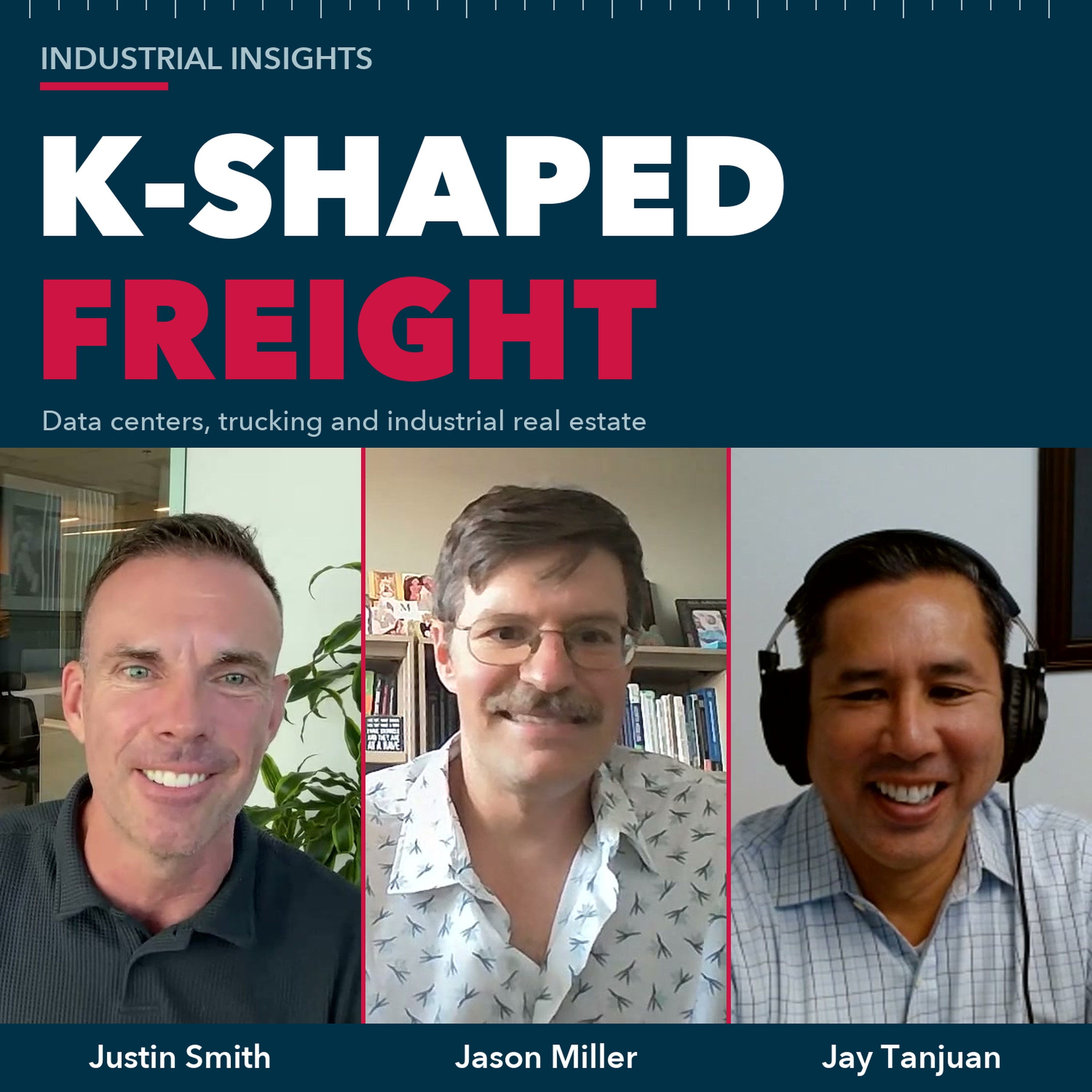
Data centers need cooling systems, steel and server racks. New homes need furniture. What happens to a trucking company when freight from one set of customers takes off and freight from the other slows down?
Michigan State University supply chain professor Jason Miller rejoins host Justin Smith and returning co-host Jay Tanjuan of Scannell Properties. Jay describes what happens when data center developers and warehouse builders bid on the same land north of Las Vegas. He also asks why busy ports in Los Angeles and Long Beach haven’t translated directly into demand for Southern California warehouses. Jason follows those containers inland and explains what rail traffic and industrial production can tell us that port totals alone can’t.
They close with a question for manufacturers weighing where to build their next plant. How do you protect a critical supply when a single factory, at home or overseas, can go offline?
Justin asks Jay Tanjuan where warehouse developers meet data center bidders. Jay takes the listener to Apex in North Las Vegas.
Justin asks how economists track a building type that had no separate line item. Jason names the two federal data sets and explains what changed.
Justin asks how data centers change Jason’s freight research. Jason shows how chips, servers and machinery appear in equipment and wholesale data.
Jason defines a K-shaped freight market through the products on each side, then explains how uneven flows affect a trucking network.
Jason tests rate sensitivity with a deliberately extreme hypothetical and explains why smaller changes are harder to predict.
Jason contrasts analyzing a large body of articles with grading a case study, where he needs to see what his students missed.
Jay asks why imports can set records amid weak consumer demand. Jason explains the role of intermediate inputs and the pace at which volume grows.
Jason starts with the Barstow rail project and explains why a freight recession can feel invisible to a household. Justin sums up the difference.
Jason compares regional order surveys with spending on battery and semiconductor plants to explain why factory indicators can move in different directions.

Jason starts in Michigan and asks what an automaker built for a global market would do differently.
Jason walks through earthquakes, winter weather and hurricanes to explain the exposure shared by suppliers in one region.
Justin asks what Jason is researching. Jason explains why shortages deserve more weight when studying a company’s decision to bring production in-house.
Read the conversation with speaker names and chapter timestamps. Select any timestamp to play the corresponding passage.
At 36:35, Jason moves from pandemic-era congestion to a separate example of imports arriving in July 2025.
The Michigan infant-formula recall and resulting U.S. shortage occurred in 2022. Jason gives the year as 2024 in the recording.
In the discussion of Nevada land bids, Jay refers to a campaign proposal to pause new data-center tax abatements during an audit. Sources for both notes appear alongside the relevant chapters in the transcript.