Industrial Insights Newsletter
Industrial Insights - Breaking Down Power Upgrades
Before you land the site, validate the power. Build to suit or existing building: capacity, cost, who pays, and when your operation can run.
Whether you are planning a build-to-suit or choosing an existing building, bring power into the search early. It can change the budget, the opening date and which site makes sense.
Before you commit, get four answers:
- Capacity. Can the utility serve your operation at this address, and what reserves that capacity?
- Work. What must be upgraded on-site and upstream?
- Cost. Who pays the utility charges and construction costs?
- Date. What supports the opening date, and what would a delay cost your business?
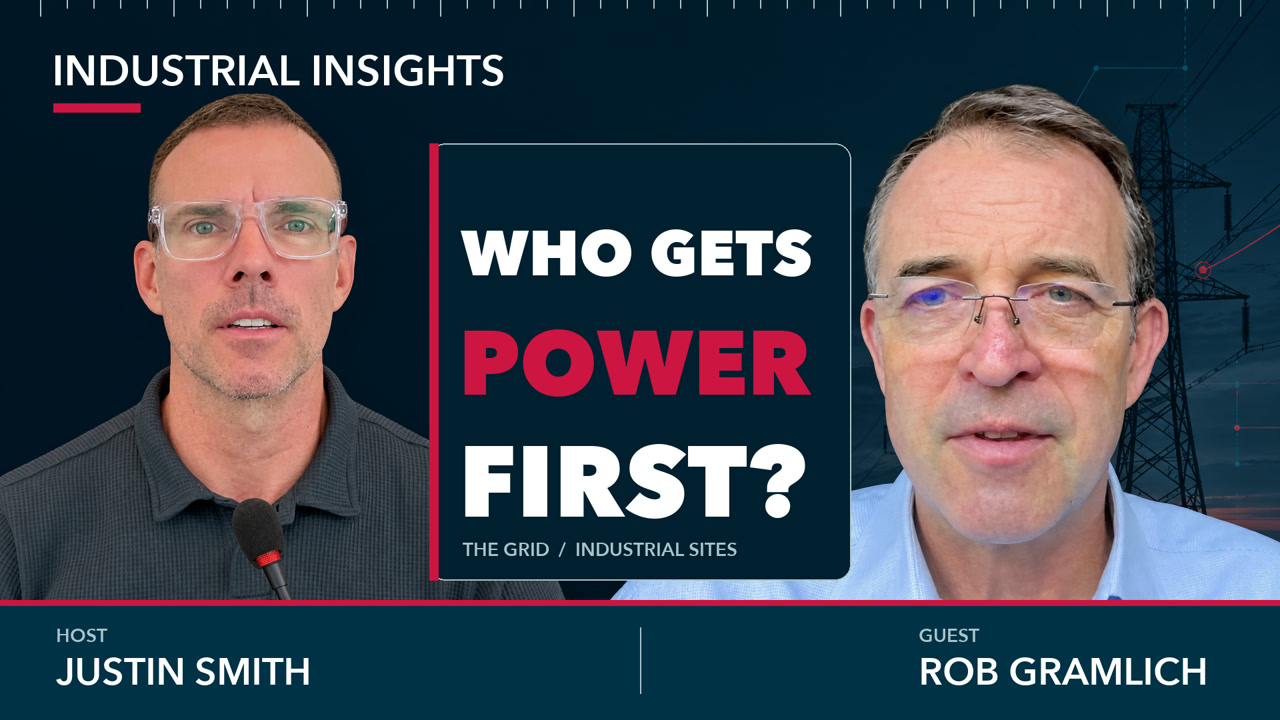
I discussed industrial site selection with Rob Gramlich, founder and president of Grid Strategies. His national perspective complements my earlier conversation with John Gaglio of Newport Utility Consulting, who works through the local utility questions. Here is how I would use both conversations in a property decision.
01 · Capacity
Confirm capacity for your operation
Review three levels: national and regional transmission, state and utility service rules, and the local circuit and site. A nearby transmission line or a building advertised with “4,000 amps” establishes neither available utility capacity nor suitability for your operation. Amps need voltage and phase for a useful comparison.
Power typically travels through transmission lines, a substation and a local distribution feeder before reaching your service transformer and building equipment. The substation steps voltage down; the feeder serves the local network. Larger sites may receive higher-voltage service and own their transformers.
For a greenfield site, establish the connection route, required upgrades and delivery plan. For an existing building, have the utility assess upstream capacity and your engineer check the transformer, switchgear or switchboard. Larger equipment alone cannot create upstream capacity.
In SCE territory: a preliminary capacity assessment costs $3,000, prepaid and nonrefundable. SCE lists a typical 20–30 business-day study after payment and complete documents. It supports planning; it does not reserve capacity or establish an energization date.
02 · Load
Give the utility a usable load summary
John recommends starting with a comparable operating facility and accounting for what will change. Connected load adds equipment input ratings. Operating demand reflects equipment running together, including peaks. Service rating describes the electrical system; it is not measured use or a utility commitment.
With your operations team and electrical engineer, I would gather:
- Actual use. Twelve months of bills and available interval data. Separate peak demand (kW) from energy used (kWh); note seasonal and idle periods.
- Equipment and operation. Quantities, input ratings and units, voltage, phase, shifts, simultaneous use, motor starts, charging schedules and power-quality needs. Include production, refrigeration, HVAC and charging.
- Growth. Equipment changes, higher throughput, extra shifts and future phases. Have the engineer reconcile these with historical demand and document assumptions.
- Site and schedule. Address, existing service, requested voltage and phase, opening date, phased demand, site plan, single-line diagram and utility-requested equipment data.
Include the loads that define your business: ovens and compressed air in manufacturing, conveyors and refrigeration in distribution, and process heat, cooling or cleanroom HVAC in food and supplement production. Adding nameplate ratings alone will not establish peak demand.
Bring in a dry utility consultant while comparing sites when power is material: service increases, heavy manufacturing, refrigeration, automation or fleet charging. The consultant coordinates feasibility, applications, utility design, costs and milestones. Your engineer defines the load and building design; the contractor prices and installs the work; the utility sets service requirements. Also involve the consultant when trenching, easements, equipment locations or owner/tenant responsibilities could affect the budget or schedule. Agree on scope early. A consultant cannot guarantee capacity or an energization date.
03 · Cost
Put power costs in the agreement
The tariff and service agreement establish obligations to the utility. Your lease or build-to-suit agreement assigns costs among the owner, developer and tenant. Utility-owned equipment can still require customer funding.
- Transmission. Carries bulk electricity over distance. Shared network projects follow approved beneficiary cost-allocation rules. Dedicated connections or project-triggered upgrades may require customer funding under the applicable tariff. Major new transmission is a multiyear concern.
- Distribution and service extensions. Deliver power locally to the building. Applicants may owe extension costs, subject to allowances and eligibility. Obtain written scope and funding terms, including the route and rights-of-way.
- Transformers. Change voltage; capacity, commonly rated in kVA, must suit the load. Confirm ownership. Utility-owned units follow utility rules, with possible customer contributions and site work. Customer-owned units belong in the construction budget.
- Switchgear and switchboards. Control, protect and distribute facility power. These are different equipment types, generally privately owned. Negotiate landlord funding, tenant funding, a TI allowance or repayment through rent. Existing lease obligations, credit, lease term, market leverage and lasting value affect the agreement.
- Civil work. Assign design, permits, easements, trenching, conduit, pads, rooms, inspections and restoration. Carry these alongside equipment and utility charges.
SCE mixed-fuel new construction: qualifying projects using electricity plus gas or propane lost former Rule 15/16 extension subsidies on July 1, 2024. SCE describes upfront estimated payment, a 15% initial contingency and an actual-cost true-up. Confirm project classification and the current invoice before assuming allowances or refunds.
04 · Date
Build the opening date around delivery
For Rule 15 distribution extensions and Rule 16 service extensions, SCE publishes an average target of 125 business days, with maximum targets of 245 and 230 respectively. These cover SCE-controlled work after a complete application. Customer work, permits and other dependencies add time; some tasks overlap. The targets do not guarantee an opening date.
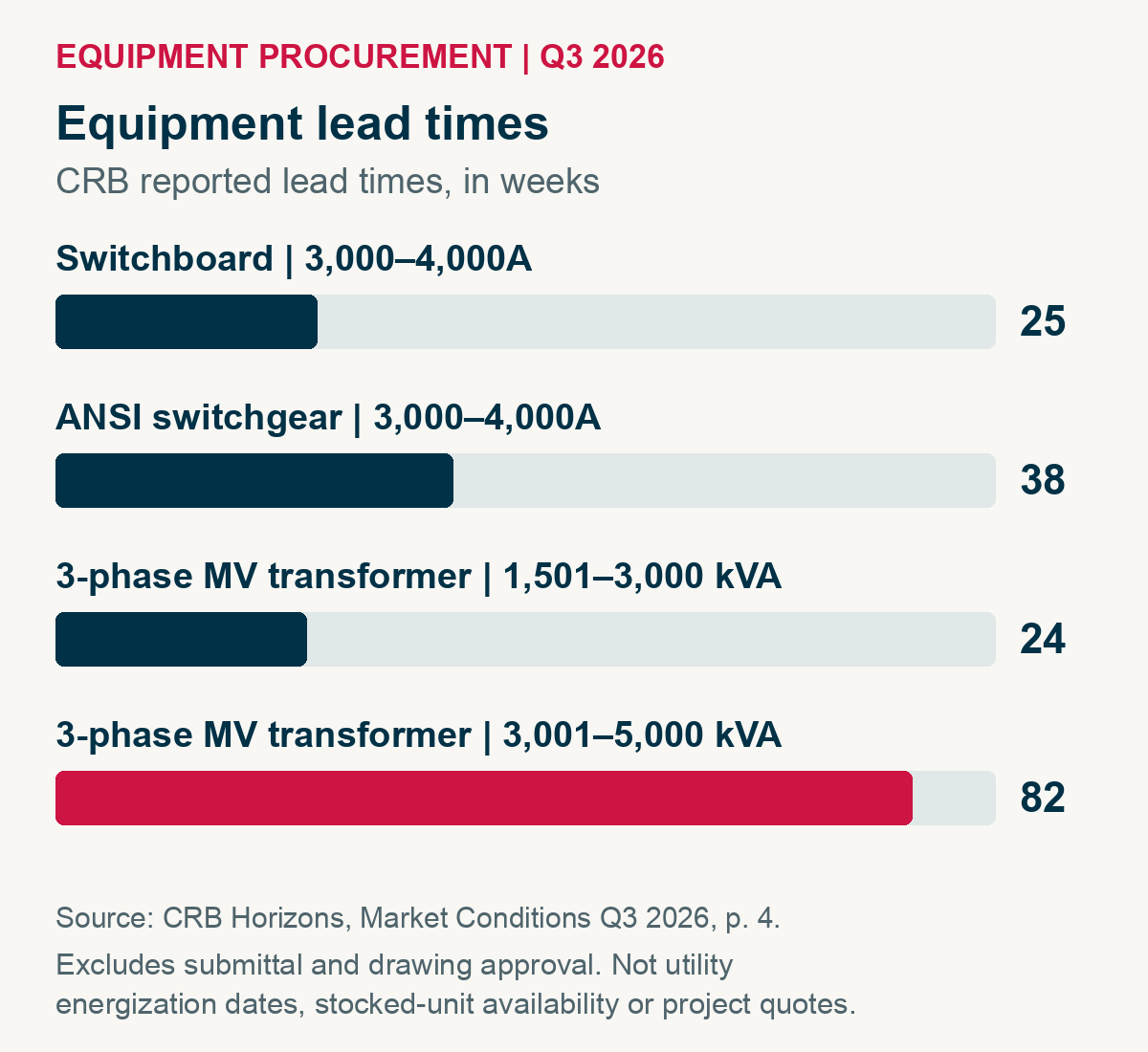
Give each milestone an owner: utility design, funding, equipment release, easements, civil readiness, installation, testing, inspection and energization. The building may be finished while one of these remains outstanding.
05 · Delay
Include delay in the site comparison
Test rent savings against the cost of opening late:
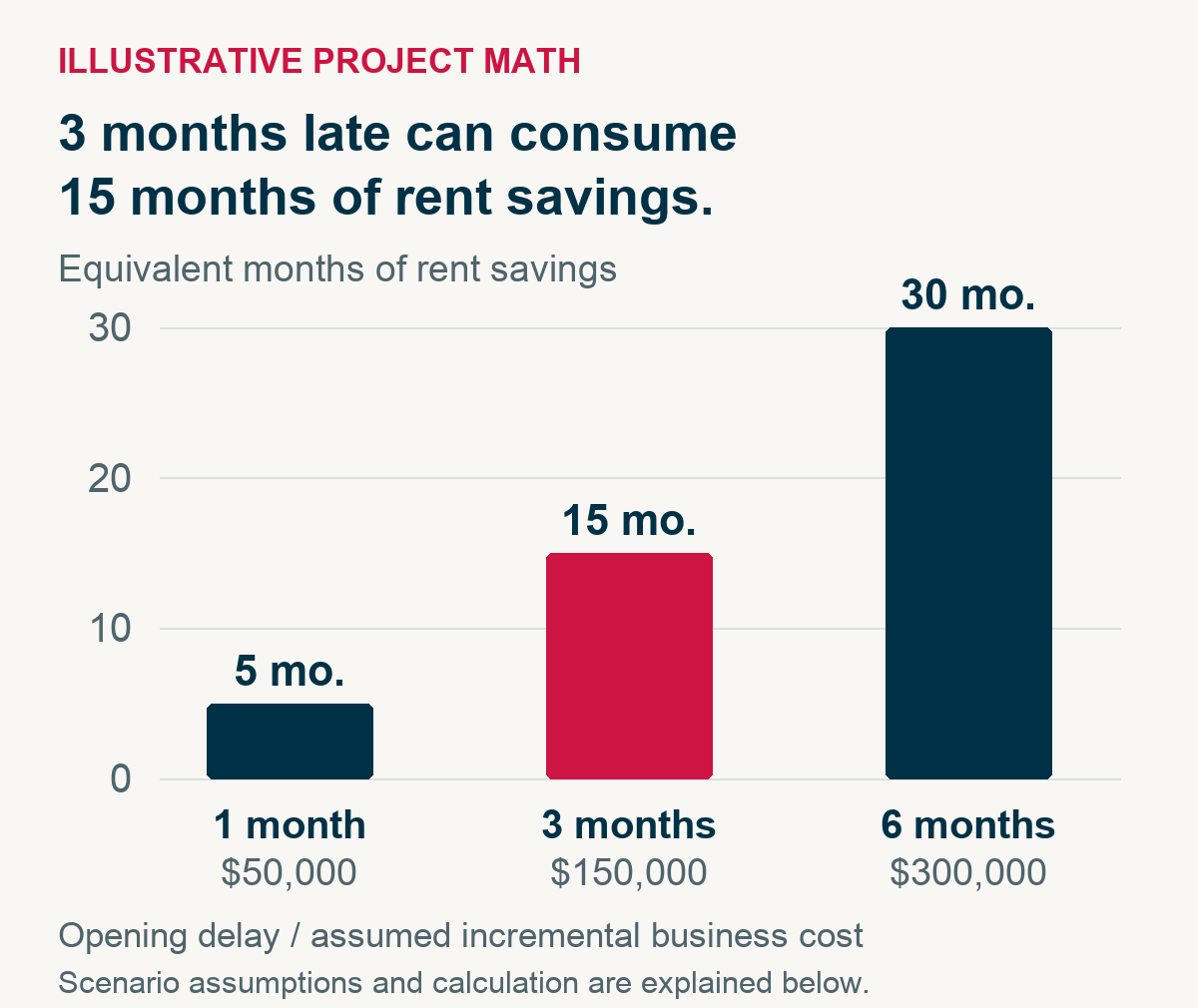
Tenants: align utility work with possession, rent commencement and operations. Owner-users: include the next expansion. Investors and owners: underwrite the target tenant’s load, timing, utility charges and construction.
06 · Policy
Transmission legislation is still a proposal
The September 30 Bipartisan American Affordability and Jobs Act of 2026 addresses transmission planning, siting, existing-corridor upgrades and transmission-cost rules for data-center and other computational loads. Rob recorded before the text was released. It remains a proposal; any eventual reform still leaves your project needing an address-specific utility assessment.
For more on local service, watch John’s conversation or read his transcript. His 2024 equipment lead times are historical; use current quotes and utility guidance.
From the desk
Evaluating a build-to-suit, lease, purchase or expansion? Reply with the address, target opening date and a little about your operation. If you are still exploring, reply “POWER.” I’ll help compare options and bring the right utility and engineering expertise into the conversation. You can start before you have a finished load study.
Senior Vice President and Principal
Smith Industrial Partners
Lee & Associates - Irvine
9838 Research Dr., Irvine, CA 92618
jbsmith@leeirvine.com | 949.400.4786
Sources
Rob Gramlich interview · John Gaglio interview · Senate announcement · Proposed bill text, §§ 2101–2103 and 2107 · SCE guidance. EIA grid explainer · Eaton equipment explainer · SCE load-planning guide · FERC cost allocation · CPUC line/service extensions. Utility and equipment sources checked October 6, 2026; interview and bill sources checked October 4, with the Senate announcement rechecked October 6. Load checklist and consultant timing are my practical synthesis. Delay-cost chart is illustrative. Procurement chart uses CRB benchmarks. Payer and negotiation guidance is my editorial synthesis; verify the applicable tariff, service agreement and lease for the project.