 |
|
Industrial Insights Economic Update
Follow the Goods: Where Three Experts Agree, and Where They Don't
November 2026
|
|
In the last few weeks I sat down with three people who watch this market from very different seats. Melinda McLaughlin runs research at Prologis, the largest warehouse owner in the world. Dr. Zac Rogers writes the Logistics Managers' Index, or LMI, a monthly survey of supply chain executives. Craig Fuller founded FreightWaves, which tracks freight as it moves.
Afterward I read all three conversations side by side and asked one question: do their stories fit together? Mostly, yes. They agree on which way things are heading. They differ on how much, and on where. The spots where their numbers seem to clash turned out to be the most useful part.
|
| The short version |
| 1 | They agree: freight is getting more expensive, disruption is here to stay, and busy ports do not mean local leasing. |
| 2 | They differ on the shopper, on how much demand has left the coast, and on how long data center demand lasts. |
| 3 | The thread: follow the goods. Who holds them, and where, decides who leases space. |
|
|
|
First, who measures what
Three gauges on the same river
Each of them watches a different stage of the same supply chain. That is why their numbers sometimes seem to disagree.
|
1 · First signal
Craig
Goods moving right now.
Freight data, weekly.
|
|
→ |
|
2 · Middle signal
Zac
What managers stock and expect next.
Survey, monthly.
|
|
→ |
|
3 · Most lasting
Melinda
Where goods stop and leases get signed.
Buildings.
|
|
Freight moves first. Inventory decisions follow. Leases come last. If you want a read on next year's leasing, watch the first two.
Melinda also gave me the question I use to sort everything below. When the market changes, is it cyclical, a swing that comes back? Or is it structural, a lasting change?
|
|
Part 1
Where they agree
|
|
Full agreement
Freight is getting more expensive
Melinda: After the pandemic there were too many trucks, so shipping stayed cheap. In its predictions for 2026, Prologis called for double-digit increases in transportation costs as the extra trucks ran out. She sees this as cyclical, and it pulls companies back toward the ports and toward 25 million people. Once you count freight along with rent, she says it is “starting to make more relative sense to expand in the area.”
Zac: In his October survey, transportation prices read 88. In his index, 50 means no change, so 88 is a fast climb. Truck capacity read 38, which means trucks are getting harder to find.
Craig: Demand is only lukewarm, but rates keep rising because the number of trucks keeps shrinking. He calls it a “Goldilocks” freight market.
|
Watch · 1:32 · Craig Fuller
“I've called it a Goldilocks freight economy... Things aren't breaking, because that's not good for anybody.”
|
|
|
Full agreement
Disruption is here to stay
This is the lasting, structural part of Melinda's frame, and all three see it.
Melinda: The cheap global supply chain built on one source is not coming back “anytime soon.” She calls site selection “cost plus.” Price still matters, but companies now pay for a partner who delivers on time through tariffs, port backups and trouble in the Strait of Hormuz and the Red Sea.
Zac: Years of disruption made supply chains stronger. He compares it to running: it hurts while you do it, but your legs get stronger. Companies now use more ports, more ways to ship and more markets.
Craig: He says we are in “the second cold war.” The Americas are the only place to buy energy that is not in a contested zone, and heavy industry “depends on energy far more than labor.”
The research: In the Prologis survey of 1,821 supply chain executives, 39% named speed as the top way to stand out, and 18% named price. Reliable power ranked first among location factors.

|
Watch · 1:14 · Melinda McLaughlin
“They don't just want the cheapest partner. They want a trusted partner who can balance all of these different factors.”
|
|
|
Agree on direction, not size
Busy ports do not mean local leasing
Zac: The Port of Los Angeles had its busiest month ever in September, about 1.04 million TEUs. A TEU is one 20-foot container.
Craig: The big importers behind that volume already have warehouses. They fill the space they have and send the rest inland by intermodal, which means rail and truck working together.
Melinda: Better rail service has helped Phoenix, Dallas, Atlanta and Memphis. But she calls the shift incremental. Most goods still move by truck.
Zac again: The hubs he expects to get tight next year are Phoenix, Atlanta, Indianapolis, Dallas and North Las Vegas.
|
Watch · 1:09 · Craig Fuller
“They're taking advantage of intermodal activity, moving stuff inland and moving stuff to the center of the country.”
|
|
| Three quieter agreements |
|
1. Big companies decide where goods sit. Craig says big importers fill their own warehouses. Zac says that last year, big retailers had smaller suppliers hold goods ahead of tariffs. His phrase for it: “JIT for me, not for thee.” Together, that explains record ports without new Southern California leases. The goods sit with companies that already have space, or with suppliers in other markets.
2. All three bring up energy and conflict. Melinda points to the Iran war and shipping lanes. Craig says energy matters more than labor. Zac says high fuel prices helped push inventory costs to 88.8 in his survey.
3. All three see political risk for data centers, on different clocks. Zac says about a dozen states moved to ban or pause data centers the week we spoke. Craig puts the big risk at 2028. Melinda lists the election among the limits on how fast they get built.
|
|
|
Part 2
Where they disagree
|
|
Mostly timing
1. The shopper
This looks like their biggest disagreement. It is mostly about when each of them spoke.
Craig, October 23: The consumer is “starting to throw off some red flags.” Consumer freight, carried in dry vans, was the weakest part of the freight market.
Zac, November 6: Retailers held back most of the year, then pulled holiday goods in at the last second in October. Amazon's October Prime Day was up $800 million from last year.
Melinda, in between: Consumers are cautious. Sales are growing, but slowly.
How both can be right: Consumer freight looked weak right up until it surged. Each of them was right on the day they spoke. Zac's test is worth watching: if Port of Los Angeles volume is still up 40% in December, goods arrived too late and will sit in warehouses.
|
|
A real difference in degree
2. How much demand has left the coast
| Stays in SoCal |
Moved inland |
|
|
Melinda
A small shift |
Zac
Middle-mile hubs |
Craig
The Midwest |
|
Melinda sees the least change. Her personal view is that the Southern California reset is “75% to 80% cyclical.” She calls the region “the most important node in any supply chain.” China's share of imports is smaller, but Vietnam, Thailand and Malaysia have more than made up for it, and their fastest route still runs through our ports.
Zac is in the middle. Ten years ago, he says, the one question was “Do you have anything in Riverside?” Now company networks run through Phoenix, Indianapolis, Dallas and Georgia.
Craig goes furthest. “The location of demand has moved to the Midwest,” where more and more freight now starts. His column The Heartland's Revenge lays out the case.
How both can be right: They are mostly describing different goods. Imported consumer goods still land in Southern California first. The new industrial growth, in energy, defense and factories, is happening inland.
One more point backs Melinda. Zac says warehouse prices are the only one of his eight measures that has never fallen nationally in ten years. Here, rents fell about 35% from the peak. A national trend that is still rising, next to a local market that fell hard, looks like a cycle, not a permanent decline. We just peaked harder.
|
Watch · 1:01 · Melinda McLaughlin
“Like we are never exiting Southern California.”
|
|
|
Agree it's real, not how long
3. Whether data center demand lasts
Craig is the most bullish. The money is private, from some of the most profitable companies on the planet, and he sees “no signs it's slowing down.”
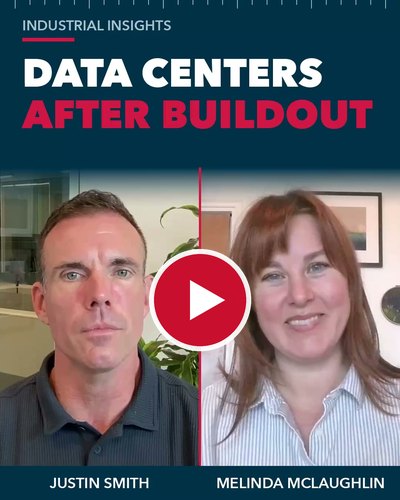
Melinda is bullish, with a limit. A new Prologis report forecasts 150 million square feet or more of related warehouse leasing by 2030. About half of that demand should be permanent, for maintenance and upgrades. These leases look like any other lease. But this is a build-out, so do not project today's pace forward.
Zac is the most cautious. He sees short, expensive leases to store servers near build sites, and state bans that could free up space. He also thinks it is healthier if industrial real estate does not lean too hard on a few tech giants.
|
Watch · 0:52 · Melinda McLaughlin
“There is about half of demand that needs to be permanent because... a data center needs to be refreshed every year.”
|
|
|
Part 3
How it fits together: follow the goods
|
|
Put the three side by side and one idea ties them together. Who holds the goods, and where, decides who leases space.
Craig: Big importers hold them in networks they already have, and ship the rest inland.
Zac: Retailers push them upstream, into middle-mile hubs.
Melinda: Southern California is still the first stop, and rising freight costs pull storage back toward the ports and people.
Where they disagree is the “where.” That is the question I will keep tracking. To follow it, you need one idea: upstream versus downstream.
|
Explainer
Upstream vs. downstream, in plain English
|
UPSTREAM
Factory → Wholesaler → 3PL |
|
DOWNSTREAM
Retailer → Shopper |
|
|
Picture goods flowing down a river. Downstream is the retailer, the last stop before the shopper. Upstream is everyone before that: manufacturers, wholesalers, distributors and 3PLs. A 3PL, short for third-party logistics company, stores and ships goods for other companies.
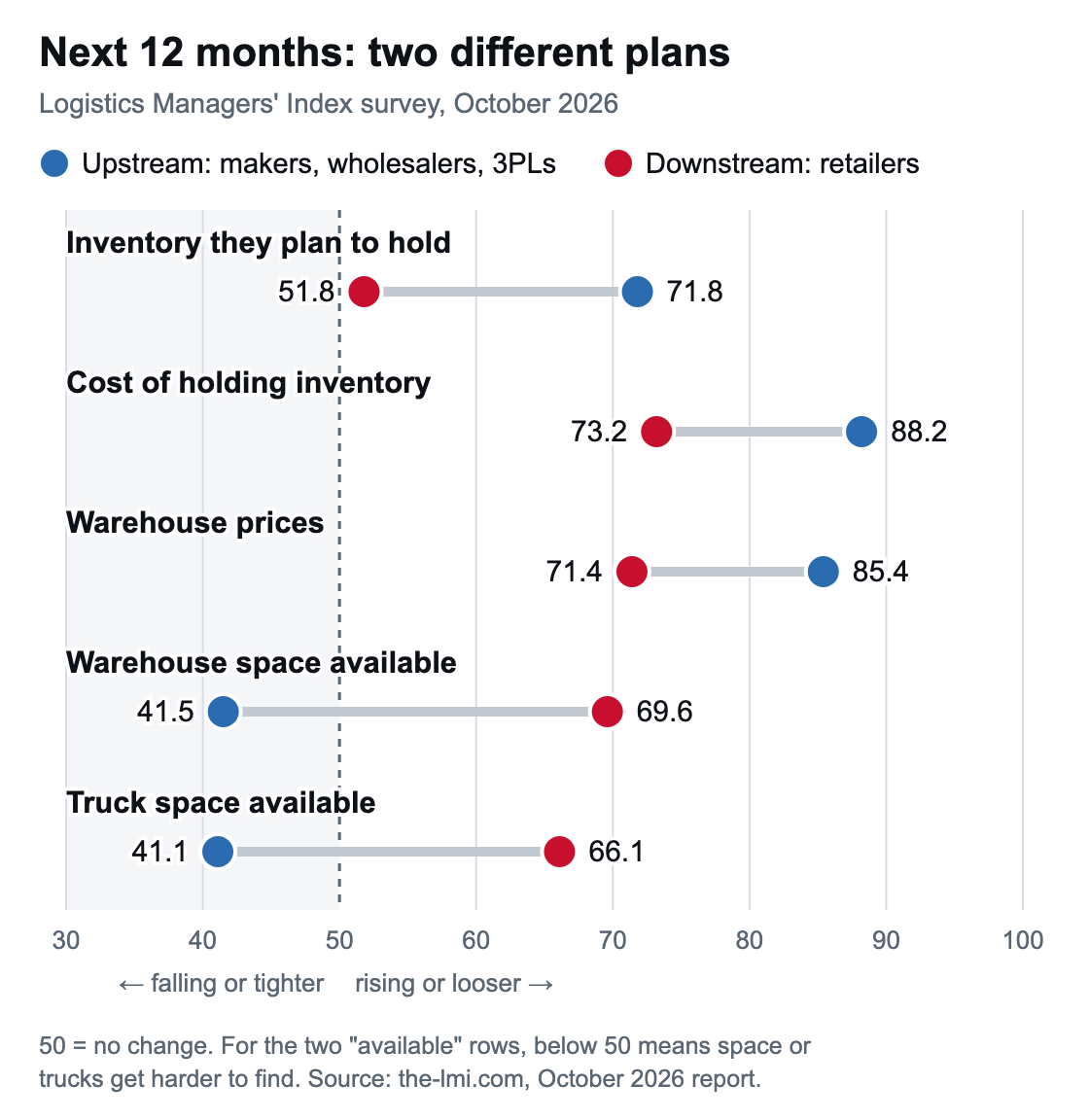
Retailers like to run “just in time,” or JIT: hold little stock and order late. But the goods do not vanish. They wait upstream until the retailer calls for them. So when retailers need less space, their suppliers often need more.
|
|
Upstream: the tortoise
Pace: slow and steady.
Freight: rail and flatbed. Craig says this side is strong.
Buildings: big regional hubs, the “middle mile.”
Next year: they expect space and trucks to get tighter.
|
|
|
Downstream: the hare
Pace: sprint and stop.
Freight: dry vans. Craig says this side is weak.
Buildings: fulfillment and last-mile sites near shoppers.
Next year: they expect space to loosen.
|
|
|
|
The middle mile is the leg between the port or factory and the final delivery run.
|
How to read the chart. Zac's October survey asks both groups what they expect over the next 12 months. Above 50 means more, below 50 means less. It is the widest gap between the two groups in the survey's ten years.

|
Watch · 1:25 · Dr. Zac Rogers
“That's where the pressure is. That's where I think we're gonna see a lot of tightness.”
|
|
What it means for you
Need a big distribution building in a middle-mile hub next year? Start early.
Leasing small fulfillment space near shoppers? You may have more leverage.
In Southern California, judge the market on several quarters, not one headline. If most of the reset is a cycle, today's rents are a window. And rerun your location math with today's freight quotes.
Talking with an AI-related tenant? Ask which work pays the rent. Maintenance stays. Construction moves on.
|
|
What I'm watching
The leasing pickup since Labor Day is real, and it is broad. To judge how long it lasts, I am watching three things: whether holiday goods sell through or sit, where freight costs go, and actual move-ins. Each one is a test of who is right about the “where.”
Prologis publishes its 2027 predictions in a few weeks. I will report back on which of these views held up.
If any of this touches a decision you are weighing, contact me and we can talk it through.
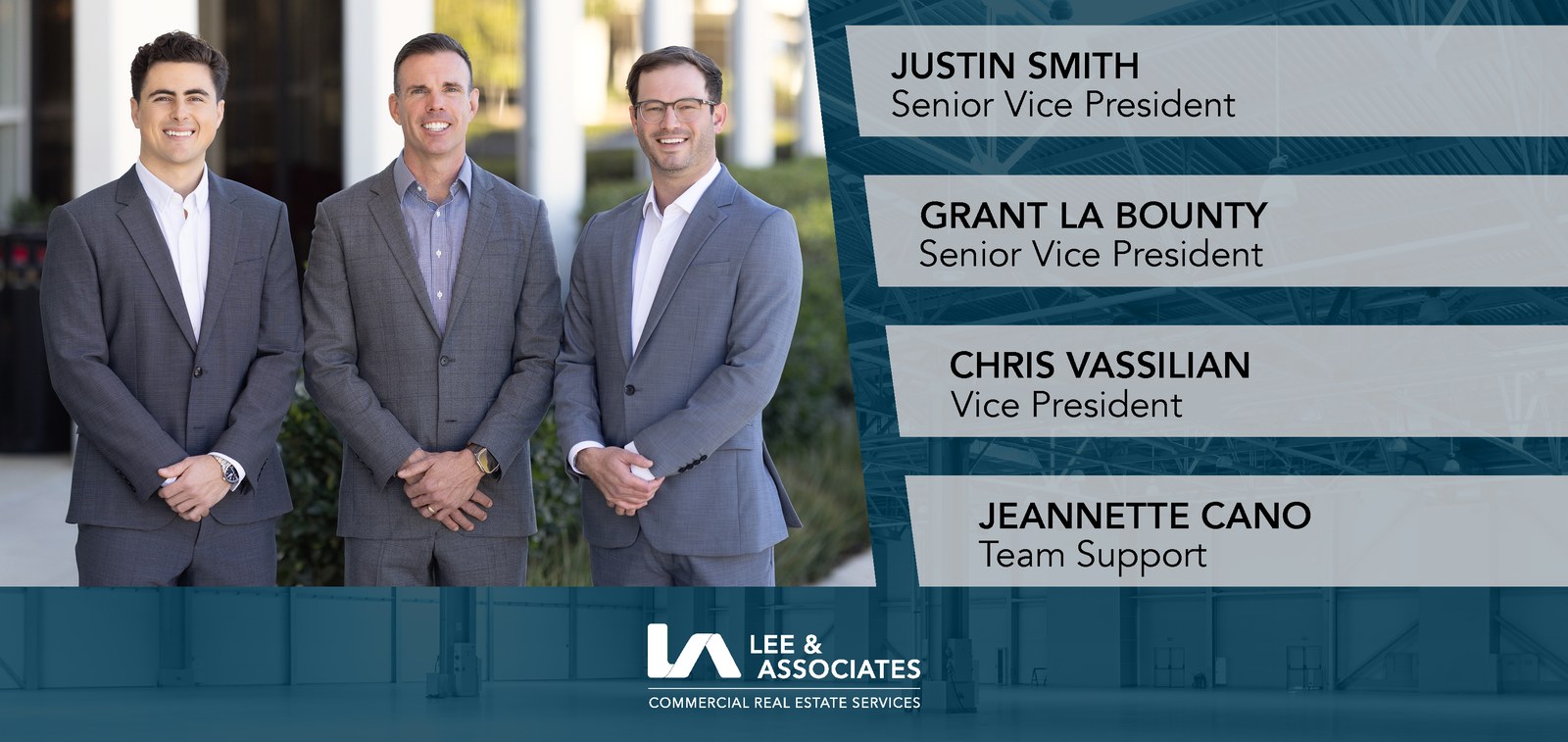
Justin Justin Smith, SIOR · Grant LaBounty, SVP · Chris Vassilian, VP · Lee & Associates | Irvine · jbsmith@leeirvine.com · 949.400.4786
|
|
Read the research
The reports behind this issue
|
Melinda McLaughlin · Prologis Research
|
|
Dr. Zac Rogers · Logistics Managers' Index
All LMI reports Free. Zac welcomes new survey takers. It is eight questions a month.
|
|
Craig Fuller · FreightWaves
|
|
|
Listen to the full conversations
|
|
Sources. Guest views come from Industrial Insights episodes recorded October 23 (Fuller), November 6 (Rogers) and November 13, 2026 (McLaughlin). They reflect each speaker's views on that date. Melinda McLaughlin's 75% to 80% figure is her personal view, not a Prologis forecast. LMI figures: October 2026 Logistics Managers' Index. Port volume: Port of Los Angeles, September 2026. Prologis Research: The Logistics Real Estate Impact of the AI Infrastructure Buildout (Nov. 10, 2026), 2027 Supply Chain Outlook with The Harris Poll (survey Aug. 3 to 20, 2026), Bold Predictions for 2026 (Nov. 2025). FreightWaves: Craig Fuller column of May 4, 2026. The Southern California rent decline is the author's estimate.
|
 |
|