Industrial Insights Newsletter
Industrial Insights — Mark to Market Leasing Update
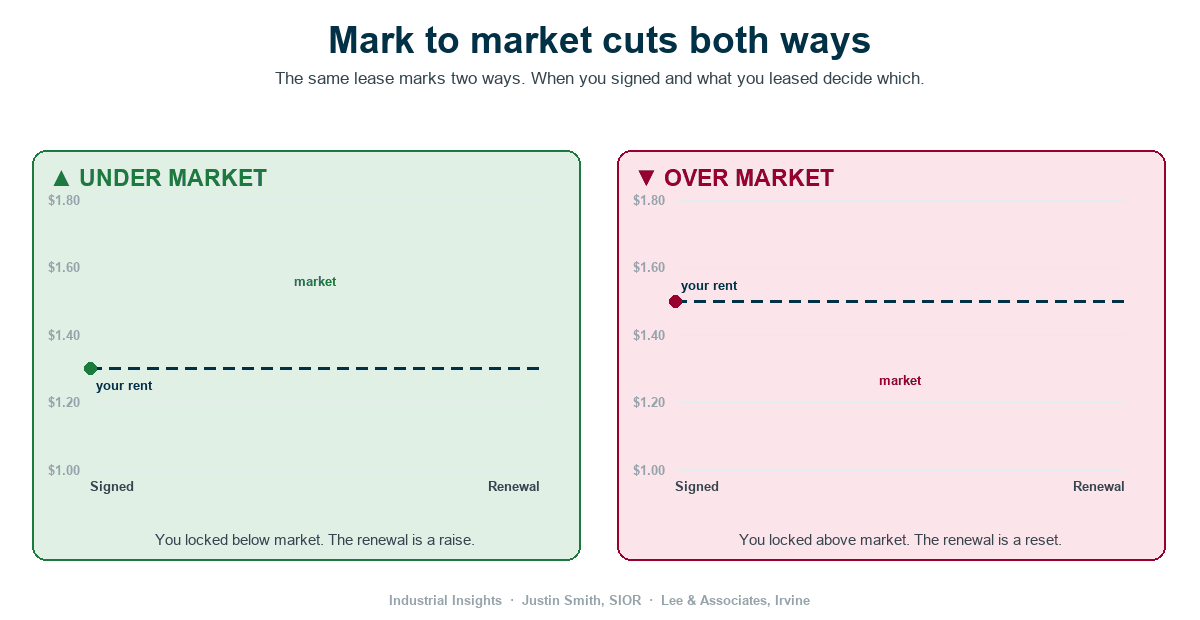
For a decade the market ran one way, up and to the right. The mark to market has flipped, and the day you signed your lease decides which way it reprices.
For a decade the market ran one direction. Up and to the right. The mark to market Prologis reported to shareholders was 76% in my first book. Today it is closer to 17%, and in Southern California it has flipped negative in many instances. Every lease coming due between now and 2028 was signed somewhere across that swing, and the day it was signed decided which way it marks.
In this issue
- The framework: the year you signed, the term you took, and your segment decide which way you mark
- Where the segments split, and both directions live in a single quarter
- The four move playbook for reading it and winning it
- The twelve terms to reopen at a reset, not just the rate
The framework
Two numbers, and the gap between them
Two things decide your mark. The first was fixed the day you signed: the year and the term. Together they locked the rate on your paper and the day it comes due. The second kept moving after the ink dried: your size band, your geography, and your building class. They set what that space rents for today. The gap between those two numbers is your mark to market. Its direction decides who holds the leverage. Its size decides how hard they push.
Run the term math and you see why this year is different. Most industrial leases run 3 or 5 years, some 7 or 10. So the leases hitting the table in 2026 through 2028 were signed between 2019 and 2023, and that window holds three different worlds:
- A 3 year lease due now was signed in 2023, at the peak.
- A 5 year lease due now was signed in 2021, in the middle of the run.
- A 7 year lease due now was signed in 2019, before the run began.
Three tenants can sit in the same building this quarter, each holding a different vintage of the same market, each carrying a different mark. And the wall is real: the REIT rent rolls show about a third of their industrial square footage repricing inside three years. Your current lease is likely one of them.
Now the other half: the market is not one market. Where your building sits sets today's number, and the segments have split hard:
- Geography: Orange County held. The Inland Empire reset by about a third.
- Size: small bay turned last. Big box turned first.
- Class: a 2015 cross dock and a 1978 metal building do not rent the same, even on the same street.
So the same signing year can mark one building up and its neighbor down. Vintage tells you when. Segment tells you which way. The mark is the distance between them.
The map below is this whole letter in one picture. Find your lease: the year and the term on the left, your size, market and building on the right. Follow it down to your direction, your leverage, and your first move.
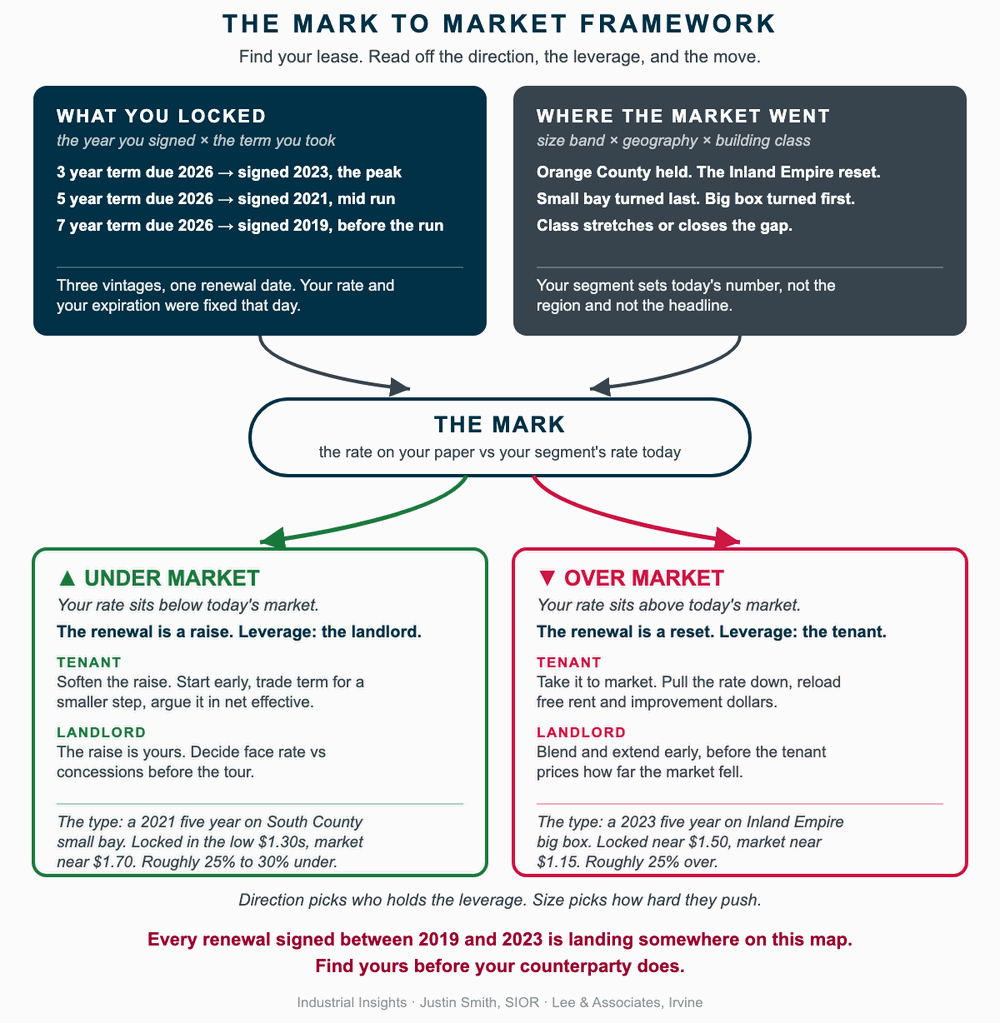
The type that marks up. A 5 year lease signed in 2021 on a South County small bay. Locked in the low $1.30s, the market now near $1.70, so the tenant is 25% to 30% under. The landlord holds the leverage and the renewal is a raise. The move: start early, trade term for a smaller step, and argue every dollar in net effective.
The type that marks down. A 5 year lease signed at the 2023 peak on an Inland Empire big box. Locked near $1.50, the market now near $1.15, so the tenant is 25% over. The tenant holds the leverage and the renewal is a reset. The move: pull the rate to market, reload the free rent and improvement dollars, and reopen the levers below.
Two leases, two vintages, two segments, opposite marks. Neither tenant did anything different. The calendar and the map did it to them.
Our proprietary comp data
The framework is not hypothetical
A REIT can tell you the market rolled. The comps we track show where, by how much, and segment by segment.
| Market | Direction | Asking (NNN) | The mark |
|---|---|---|---|
| Orange County | Softening | $1.54 median | roughly at market on renewal |
| Los Angeles | Softening | $1.30 median | concessions leading, net effective down |
| Inland Empire | Marking down | $1.09 median | off 34% to 39% from peak |
| Phoenix | Marking up | up ~6% YoY | small bay tight, big box resilient |
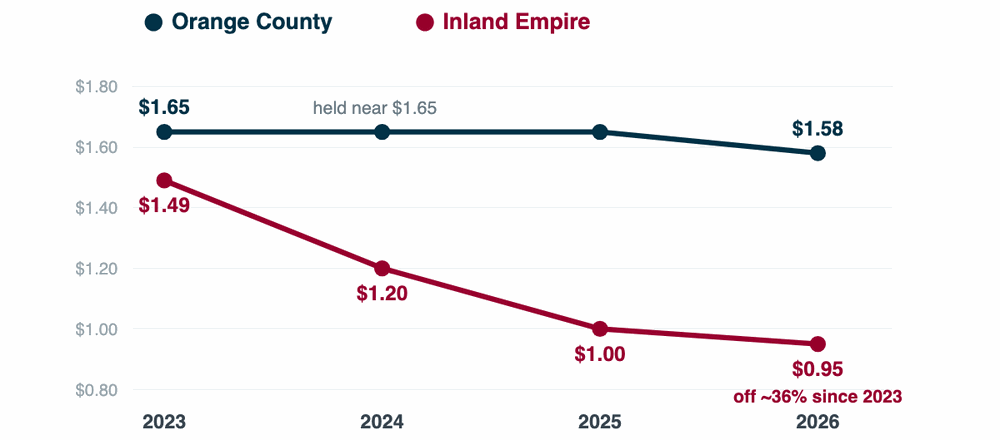
Illustration, not the framework: how far two segments split from the same line. Orange County held, $1.65 to $1.58 since 2023. The Inland Empire reset, $1.49 to $0.95, off about 36%. Your segment draws its own pair of lines.
Size runs on its own clock. Small bay under 10,000 SF kept climbing into 2025, from $1.65 to $1.70 to $1.75, then gave it back this year at $1.48. It turned last. Big box over 100,000 SF turned first and fell furthest, from $1.53 to about $1.12.
The spread inside one market is as wide as the spread between markets. Pooled across 2024 to 2026, Orange County small bay runs near $1.70 while Orange County big box runs $1.20 to $1.30. The Inland Empire inverts it: small bay near $0.97, under big box near $1.14. Same county, same year, opposite ends.
Market inventory makeup matters. OC looks to have been more resilient, but that big box over 100,000 SF still decreased markedly. Why doesn't that show up in the blended data? Small bay is the majority of the Orange County market. In the Inland Empire, big box is the majority. The inventory mix skews the average.
Which way, right now
Both directions live in the same quarter
Geography is the switch.
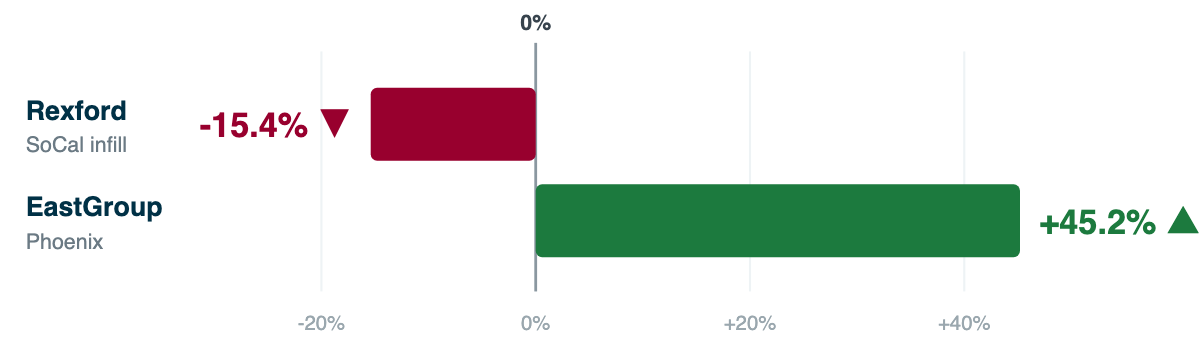
- Rexford, Southern California infill: a negative 15.4% cash spread last quarter.
- EastGroup, Phoenix: 98% leased, marking rents up more than 40% on a cash basis.
- Prologis, national: about a 17% net effective mark to market, still signing space about 32% above the expiring rent.
Hold onto one fact before you negotiate: both landlords sit near 95% occupied and defend it. The landlord's first fear is the empty building, not the rate. That is the whole game. Here is how it gets played.
The playbook
Four moves for reading it and winning it
Move 01 · Read it in net effective, never in face rate
The rate on the survey or lease comp doesn't tell the whole story. Two deals at the same face rate can sit a full tier apart once you count the free rent and the improvement dollars. That is exactly why a REIT reports the same lease two ways, cash and net effective. Convert everything and the real mark appears; compare on asking rates and you misread every deal on the table.
Move 02 · Pick the structure: low base and no concessions, or higher base and heavy concessions
The same net effective deal papers two ways, and the choice is never an accident. A low base rate hands the tenant a clean number, but it cuts the face rate that sets the comp and the building's value for years. A higher base rate wrapped in free rent and improvement dollars protects the face and gives the value back as one time items that expire. Same cost this year, very different sale price later. Decide which you want before the first number is exchanged.
Move 03 · Find out which one the landlord actually needs
Every landlord prefers one structure, and the preference leaks. An institution, a REIT, or any owner heading into a sale or a refinance defends the face rate and gives you the world in concessions, because buyers and lenders underwrite the rent roll on face rates. A private owner who needs clean cash flow may take the lower base. The tell is behavior: firm on the asking rate, generous on free rent, means they are protecting the comp. Ask the broker which matters more, the rate or the term, and read the answer.
From the comp set: the give is real, and I can measure it. Across the 2024 comps we track, the median deal ran a $1.55 face rate but a $1.44 net effective rate once free rent and improvement dollars are counted. That 7% is the gap between the number on the sign and the real economics, and it never shows up on an asking sheet.
Move 04 · Control the clock: commencement, blend and extend
When the mark hits depends on when the lease starts. In a climbing market, commence immediately: lock today's rate before it moves and start the free rent now. In a falling market the move is blend and extend, trading a longer term for a rate between your above market rent and today's. The wider the gap, the more the timing is worth to whoever moves first.
Do not stop at the rate
The reset reopens the whole lease
The mark is the leverage; the rate is only the first line it buys you. When the mark runs your way, this is the lever set most people leave on the table. When it runs against you, this is the list you defend.
The money terms
- Reset the base year. Push the operating expense base year or expense stop to the current year, so tax, insurance and CAM pass throughs start from today, not from a number set years ago.
- Push the escalations back down. The 3.5% to 6% annual bumps written in 2021 and 2022 do not have to carry forward. Negotiate the increase down and watch the timing of the first one: the compounding is where the real money hides.
- Front load the free rent. Months taken up front are worth more than the same months spread across the term, and they fund the move or the build.
The building
- Make the landlord cure the deferred maintenance: the roof, the HVAC, the parking lot, the dock equipment. The reset is your one clean shot at getting the building brought to spec on the owner's dime.
- Shift the capital and HVAC replacement to the landlord, or cap your exposure and amortize it over the useful life, so a compressor failure is not your bill.
- Waive the restoration and surrender obligation, the duty to rip out your own improvements at move out. It is one of the largest hidden costs in any lease.
The paper
- Amendment or new lease, decide on purpose. An amendment is fast and keeps every term you already fought for. A new lease fixes the bad clauses but reopens everything, so pull that lever only when the old lease works against you.
- Loosen assignment, sublease and recapture, so you keep flexibility if your space needs change before the term is up.
The protections and the options
- Ask for new options to extend, at market or at a fixed rate. Optionality is cheap for the landlord to grant and valuable for you to hold.
- Reset the security deposit. With tenure and better credit you can reduce it or burn it down over time. Landlords push to raise it on a longer term, so hold the line.
- Reduce or release the guaranty or the letter of credit. After years of on time rent, they are the first things to negotiate off.
The mark decides how much of this list you get. In a soft market, reach for all of it; in a tight one, defend what you hold. Either way, know why the landlord will deal at all.
The landlord's math
Keeping a tenant beats replacing one, almost every time
Plenty of landlords forget it in the moment. Lose the tenant and the owner gets a dark building, a make ready bill, marketing and open houses, a full leasing commission, a fresh improvement package, and a bigger free rent deal, all before a dollar of new rent arrives.
| Line item | Renew the tenant | Lose them, lease it up again |
|---|---|---|
| Face rate | market, say $1.20 NNN | maybe $1.25, after the gap |
| Downtime | none | about 10 months dark |
| Lost rent and carry | 0 | about $1,400,000 |
| Make ready | 0 | about $300,000 |
| Marketing and open houses | 0 | about $40,000 |
| Leasing commission | small renewal fee | about $375,000 |
| Tenant improvements | light | about $1,000,000 |
| Free rent | a month or two | about $480,000 |
| All in to the landlord | about $450,000 | about $3,600,000 |
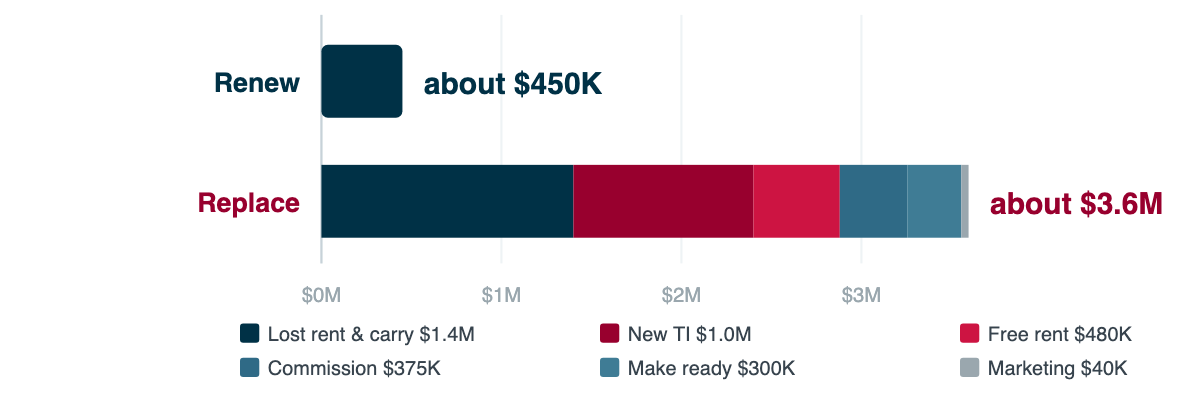
Same building, and the owner is more than $3,000,000 better off keeping the tenant it already has, before the new lease even starts and even when the new tenant signs at a higher face rate.
The cheapest tenant a landlord will ever sign is the one already paying rent. The ever shifting leverage is exactly why blend and extend exists: the landlord trades a little rate for term and occupancy and still comes out ahead.
One note on the vocabulary, because it has a gap. Blend and extend is the move when your in place rent sits above market: blend the high rate down, lock a longer term. But when there is nothing to blend, when the rate already sits at or below market and the landlord is simply cutting to today's number and adding years, the business never named the move. Call it bend and extend. Take the l out of blend and you take out the pretense: nothing is blending, the landlord is bending on the rate to keep the building full.
From the desk
Send me a building and I will run the mark to market on it: the year you signed, the term, the size, and the address. I will run your in place rent against your segment's market and the executed comps we track, tell you which way it reprices, by how much, and what to do about it before your counterparty does.
Senior Vice President and Principal
Smith Industrial Partners
Lee & Associates — Irvine
9838 Research Dr., Irvine, CA 92618
jbsmith@leeirvine.com
Sources
Executed industrial lease comps tracked by Smith Industrial Partners, 2024 to 2026. REIT figures: Prologis, Rexford Industrial and EastGroup Properties Q1 2026 earnings materials.