Industrial Insights Newsletter
Industrial Insights: Renew or Relocate
Renew or relocate? The cost of moving usually decides it.
We have a rule of thumb in our industry: tenants don’t move to a building the same size just for cheaper rent. Why? The cost of moving.
I have had clients tell me they would rather retire than move their warehouse again. Funny, I know, but it tells you how much a move disrupts people’s jobs. It means two to three times the normal workload for people who still have to get their day jobs done.
So, especially when market pricing is moving around, it pays to know your cost of moving before you need it. It tells you the value of staying in your space, the capital you will need for next year’s budget, how sticky you look to your landlord at renewal, how much time you need to find real alternatives and keep your leverage, and how to deliver a move on time, on budget and without service delays to your customers.
The Industrial Relocation Guide prices it. It builds on the three cost buckets from Industrial Intelligence (new site setup, the physical move and the exit from the old building) with a full operating analysis for distribution centers, 3PLs, manufacturers, and food and supplement plants.
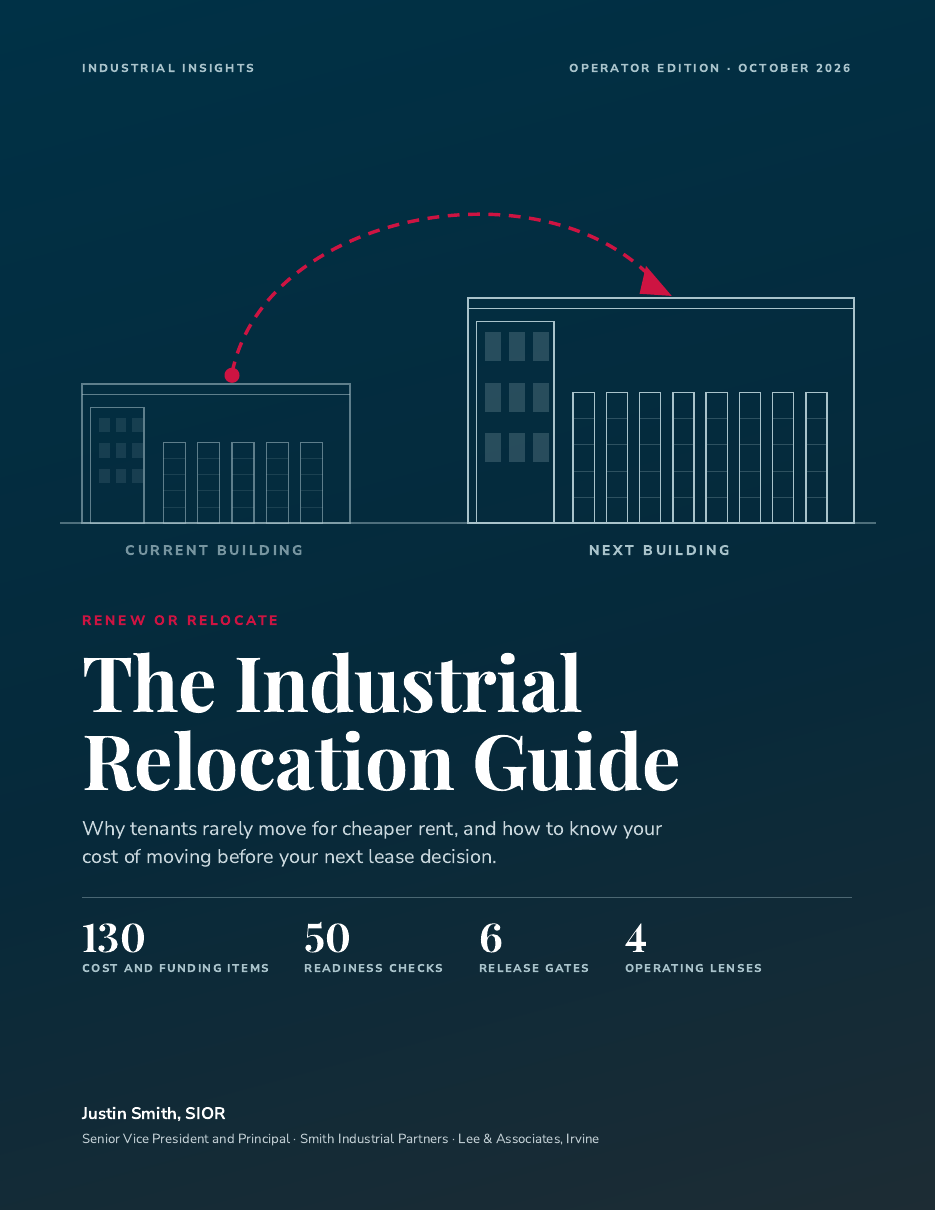
44 pages · 130 cost items · 50 readiness checks
The Industrial Relocation Guide
- 130 cost and funding items in 13 categories, each with a scope and quote basis
- 50 readiness checks with the evidence to collect and an acceptance test
- Separate lenses for distribution centers, 3PLs, advanced manufacturing, and food and supplement plants
- Payback charts, a 32-activity Gantt with six release gates, and an editable decision workbook
Free downloads, no signup needed
Part 1 · The decision
Start with the cost above staying
The question is never what the move costs. It is what the move costs more than staying, and what the operation gains or gives up every year after.
Compare the same business outcome
Use the same peak demand, quality standard, service promise, equipment scope and time horizon in both cases. A stay case can include upgrades the building needs anyway; a move case can include better capacity. Write the differences down.
Include the full occupancy package
Compare effective rent, taxes and NNN, insurance, utilities, maintenance and committed incentives. Keep annual occupancy items in the same schedule as other recurring changes so rent savings are never counted twice.
Use a fuller model before you commit
Simple payback is a screening tool. Before you sign, model annual cash flows, escalations, timing, incentives, financing, taxes and residual value for the real alternatives.
When savings are zero or negative
There is no positive payback. A move made for capacity, service or growth can still be right, but it needs its own business case rather than a rent comparison.
Part 1 · The decision
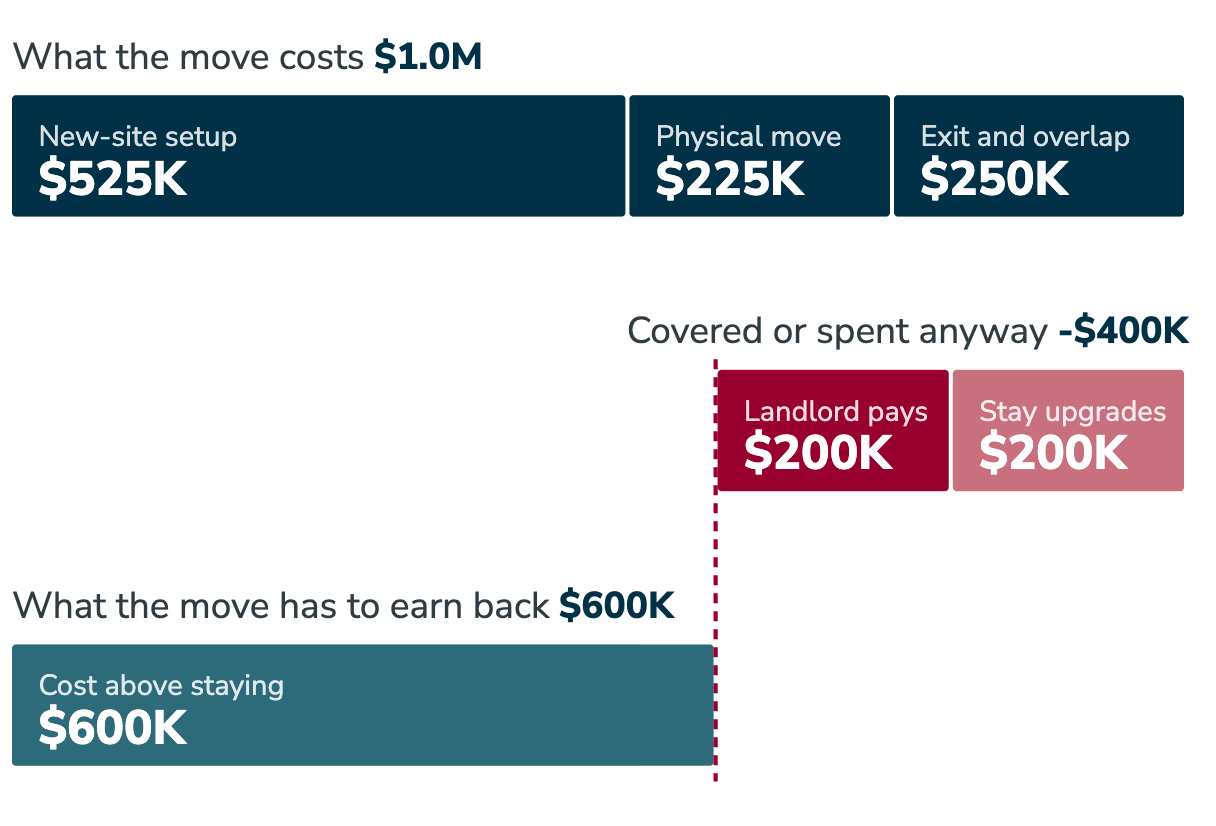
A $1 million move can be a $600,000 hurdle
Of a $1.0 million move, $400,000 is either paid by the landlord or spent anyway if you stay. The other $600,000 is what the move has to earn back. Illustrative 100,000 SF operation; every number is a planning assumption.
Contributions arrive late
Keep the landlord contribution’s eligibility, cap and payment timing in the funding plan. A reimbursement paid after completion lowers the eventual cost but still leaves you funding the work first.
Stay upgrades need a real scope
The $200,000 to stay belongs in the comparison only if it is supported by scope. It should never be inserted to make a move look better.
| Component | Amount |
|---|---|
| New-site setup | $525,000 |
| Physical move | $225,000 |
| Origin restoration | $100,000 |
| Overlap and disruption | $150,000 |
| Gross move cost | $1,000,000 |
| Less landlord contribution | -$200,000 |
| Less realistic stay upgrades | -$200,000 |
| Cost above staying | $600,000 |
Part 1 · The decision
A cheaper lease is only part of the savings
At 100,000 SF, a $0.15/SF/month rent reduction saves $180,000 a year. The same rent offer has three very different outcomes once operating costs move.
Simple payback on a $600,000 cost above staying: $600,000 ÷ $60,000, $180,000 or $240,000 of annual net savings. Equal annual savings assumed.
Why the annual number moves
Test freight and drayage, employee retention and wages, utilities and demand charges, maintenance, outsourcing, additional handling and recurring systems costs. Itemize both savings and increases in cost items 111 to 120.
Turn productivity into dollars
A better layout can raise output per labor hour. It becomes a cash benefit only through something you can point to: avoided overtime, lower staffing cost, avoided outsourcing or profitable throughput. Record the mechanism and what it takes to achieve it.
Part 1 · The decision
Solve for the rent discount you need
Turn the question around. Instead of asking how long a rent offer takes to pay back, ask how big the discount has to be.
Undiscounted recovery test, not an investment valuation. Required discounts can be zero or negative when supported operating savings cover the hurdle. Adjust for area differences, stepped rent, expense recoveries and cash-flow timing.
Part 1 · The decision
Test the rent spread against the capital hurdle
Simple payback in months for a 100,000 SF operation with other costs unchanged. Read across for a bigger discount, down for a bigger move.
Monthly rent discount per SF →
| Cost above staying | $0.05 | $0.10 | $0.15 | $0.20 | $0.25 |
|---|---|---|---|---|---|
| $400K | 80 | 40 | 27 | 20 | 16 |
| $600K | 120 | 60 | 40 | 30 | 24 |
| $800K | 160 | 80 | 53 | 40 | 32 |
| $1.0M | 200 | 100 | 67 | 50 | 40 |
| $1.2M | 240 | 120 | 80 | 60 | 48 |
Read across a row
At a $600,000 cost above staying, moving from a $0.05 to a $0.15 monthly discount changes payback from 120 months to 40.
Read down a column
At a $0.15 discount, a $400,000 move pays back in about 27 months. A $1.0 million move takes about 67.
Arithmetic on assumptions, not a survey of relocation prices. No escalation, discounting, tax, financing or residual value. The companion workbook recalculates this matrix with your operating-cost and NNN inputs.
Part 1 · The decision
Price the project. Then fund the transition.
Five kinds of money move through a relocation. Blending them is the most common way a good move gets a bad budget.
Setup, relocation, exit, staffing and disruption belong in the project comparison. Separate cash spend from economic loss and from capital expenditure.
Enter move and stay costs on a stabilized basis. Show the ramp separately; a full year of savings does not begin on the first operating day.
Deposits and extra inventory need cash even though they are not expenses. Financing, spoilage and extra handling on that inventory are separate costs.
Landlord contributions, asset sales and other recoveries need written conditions, collectible amounts and receipt dates.
A separate allowance for identified uncertainty. Never use it to hide missing scope or stack it on an allowance already in a vendor quote.
Watch the lowest balance
Record the lowest weekly balance, not just the final net cost. Reimbursement dates, overlap rent and inventory build usually drive the peak requirement.
Count lost margin, not lost revenue
For disrupted orders, estimate contribution margin after avoidable variable costs and backlog recovery. Reconcile idle payroll, expedited freight and overtime so each impact is counted once.
Part 2 · Operating lens 1 of 4
Distribution centers: prove usable throughput
A distribution center is only as big as the capacity it delivers on the busiest shift.
Size the operation at peak
Receiving by hour, orders and order lines, pallet and carton dimensions, pick mix, replenishment cycles, returns and seasonal on-hand. Count quarantine, staging, empty pallets and charging space as well as sellable stock.
Convert the shell into a layout
Test usable positions, clearances, column interference, lift height and aisle geometry. Confirm rack engineering, slab, sprinkler compatibility, docks, trailer circulation and dispatch staging for the actual commodities.
Protect inventory and system truth
Create origin-to-destination locations, wave manifests, scanned receipts and count reconciliation. Rehearse receive, putaway, pick, pack, ship and return, including labels, carrier feeds, RF coverage and recovery from a failed cutover.
Measure acceptance
Agree on sustained lines or orders per labor hour, inventory accuracy, error rates, dock turn time and on-time shipment at the design peak. Write the sample period and tolerances before the move.
Useful questionHow much sellable, accessible capacity will this layout deliver on the busiest shift after reserve, staging, quarantine and travel paths are included?
Commonly missed
Rack reuse versus new procurement. Floor repairs and anchors. RF surveys after the racks are installed. Overflow storage. Extra touches during dual operation. Trailer and carrier changes. Returns that keep arriving at the old address.
Part 2 · Operating lens 2 of 4
Logistics and 3PL: move each customer safely
A 3PL does not move a building. It moves every customer’s service promise, one account at a time.
Turn contracts into wave constraints
List SLAs, blackout dates, required approvals, order cutoffs, penalties, custody terms and inventory ownership. Sequence the migration by account, SKU and lot, and service sensitivity, not by a percentage of floor space.
Recalculate the network
Model lanes, drayage, port and rail access, fuel, tolls, detention, empty miles, driver hours and carrier schedules on actual volumes. A lower rent can raise transportation cost enough to reverse the comparison.
Keep billing and custody intact
Map customer and location masters, rate tables, EDI and API feeds, balances, cycle counts, access controls and proof of delivery. Test billing through both sites and reconcile stock by owner and status.
Give each wave a recovery plan
Name the command lead, the dispatch, IT and customer escalation paths and the rollback trigger. Reserve the capacity critical customers need while their wave is unavailable.
Useful questionWhich customers could lose service during this wave, and what inventory, staffing and system capacity remains available to them?
Commonly missed
Ship-to and ship-from addresses, ASN instructions, labels, appointments, returns, carrier routing and after-hours contacts. Written customer acceptance wherever the contract requires it.
Part 2 · Operating lens 3 of 4
Advanced manufacturing: install a process, not just machines
A machine on a new floor is not production. Saleable output at rate is.
Map the current process first
Record material routes, work in process, changeovers, scrap, rework, constraints and maintenance access before you draw the future layout. That is where the flow improvements, and later automation, come from.
Resolve utilities at each asset
Voltage, phase, load, air pressure and quality, water, drainage, gases, exhaust, heat rejection and controls. Verify foundations, pits and vibration. Keep rigging, final hookup and OEM commissioning as separate scopes.
Move in controlled waves
Asset IDs should connect origin, destination, shutdown method, lift and transport plan and reconnect requirements. Stage the work so installed equipment is never trapped behind the next wave.
Qualify performance at the new site
Startup is followed by calibration, process qualification, test parts and customer or quality release. Define throughput, yield, tolerances and sustained run time before accepting a line.
Useful questionWhat must pass after this machine is reconnected before we can sell the output and depend on its production rate?
Commonly missed
Realistic buffer stock and alternate production. Supplier and customer commitments. Equipment that cannot be duplicated, components with uncertain restart behavior, and OEM technicians with limited availability.
Part 2 · Operating lens 4 of 4
Food and dietary supplements: make product release explicit
In food and supplements, mechanical completion is not permission to ship.
Design storage and process separation
Map ingredient receipt, quarantine, release, allergens, personnel and material routes, sanitation, waste and finished goods. Scope surfaces, drainage, utilities, temperature, humidity and air for the actual hazard and process.
Carry traceability through the transfer
Keep lot identity and status for ingredients, labels, packaging, work in process, retained samples and released stock. Control label versions so a transfer never bypasses hold and release rules.
Treat startup as a quality workstream
Define calibration, cleaning verification, water and air checks, process qualification, trial batches, lab tests, documents and release authority. Price the material and time for trials, rejects and delayed saleable output.
Check site and customer obligations early
Have the quality and regulatory owner confirm registrations, permits, certifications, customer audits and food-safety plans for the new site. Do not assume anything transfers automatically.
Useful questionWhat evidence lets us release this line and product family, and what remains on hold?
The regulatory frame
FDA’s Part 117 covers human food CGMPs and preventive controls; Part 111 covers dietary supplement CGMPs. Applicability and exemptions depend on the operation. Record exactly what is authorized to run and ship, and what stays on hold.
Part 2 · The operation
Three public facts that change the plan
Each one is small. Each one shows why a relocation has to be planned around evidence rather than dates.
and 20 to 30 business days for a power study
SCE’s Preliminary Capacity Assessment (PCA) report costs $3,000, paid in advance and nonrefundable, and the clock starts only after payment and complete documents. It is preliminary planning information. It does not reserve capacity and it is not an energization date.
Southern California Edison [7]reported savings from measured layout planning
A NIST/MEP success story published October 29, 2024 describes a chemical manufacturer that planned its move with measured equipment data and digital layouts. One case, not an expected return, but a clear argument for measuring before you move.
NIST / MEP [3]food facilities consolidated into one
JBA describes Wellington Foods consolidating six Long Beach facilities into an 82,000 SF Corona facility, with process piping and production planning as part of the project. Vendor-reported and undated.
JBA [2c]For fire protection, storage design and workplace safety, use the applicable authority, your insurer and qualified engineers. OSHA’s warehouse guidance and FM’s data sheets helped define review topics; this guide is not a building-specific design review. [5, 6]
Part 3 · The execution
Plan the interfaces, not the truck date
An illustrative 32-week master schedule with six release gates. Week 0 is the first approved operating release, not the day the trucks roll.
Gates are planned dates only; utilities, permits and OEM lead times can stretch the project. A relocation needs more runway than a renewal, so start the real estate search well before Week -24.
Part 3 · The execution
Six gates prevent premature commitments
A calendar milestone is a target. A signed release supported by evidence is the operating decision.
Site feasibility
Operations, facilities, finance and the sponsor accept use, power, floor, fire and storage fit, staffing and economics before the lease is executed.
Scope and budget freeze
Issued scopes cover vendor interfaces and exclusions. The budget shows allowances, pending items, incentives and timing. Design changes follow written change control.
Destination ready for the first wave
Affected zones have safety and authority acceptance, usable utilities, storage, systems, access and staffed capacity. One named person releases the transfer.
First operating release
Equipment, process, transactions and product quality pass their defined tests. Later waves repeat the checks; they do not inherit permission from the first.
Stable performance
The agreed peak case runs for the agreed duration with acceptable service, inventory accuracy, yield and staffing.
Origin surrender
The old facility meets the written restoration conditions. Inspection, keys, meters, condition evidence and landlord acceptance are documented before the deadline.
Part 3 · The execution
Make every vendor boundary visible
Ask competing vendors to price the same asset inventory, quantities, drawings, wave plan, access assumptions and acceptance tests. Otherwise the low bid may simply be missing a handoff.
The interface matrix: for every asset, name the owner of each of these ten steps and the evidence that hands it to the next. One blank cell becomes an unplanned crew, a delay or a claim.
Attach a quote basis
Inclusions and exclusions, site access and hours, load and utility assumptions, quantities, permits, shipping, overtime, taxes, cleanup, insurance, allowances, escalation, cancellation, change-order rates and a validity date.
Name the acceptance test
Drawings and as-builts, inspection records, safe startup, performance tests, quality documents and defect closeout. Tie progress billing and retainage to clear deliverables rather than percent complete.
Ask for uncertainty in writing
A site walk by a relocation specialist can tighten the estimate considerably. Ask the estimator to state the scope, fee, basis, range, exclusions, contingency and expiration.
Manage the project as the owner
Designate a move manager and an executive escalation owner. Keep a decision log, daily wave readiness, open defects and versioned budgets.
Part 4 · Cost inventory · Category 01 of 13
Planning and advisers
The people who define the scope before anyone prices it.
One-time project cost unless tagged. Enter move and stay amounts; blank means unknown, not zero.
| # | Item and scope | Quote basis | Move | Stay |
|---|---|---|---|---|
| 001 | Relocation feasibility study Compare move and stay alternatives, operating needs, schedule and risk; exclude specialist work priced below. | Alternatives studied; sites visited; deliverables; exclusions | ||
| 002 | Relocation project management Owner-side coordination, master schedule, change control and move supervision; avoid duplicating GC general conditions. | Project duration; phases; site coverage; authority and change-control scope | ||
| 003 | Architectural design Drawings and specifications for the new facility; separate permit fees and construction. | Area and drawing packages; redesign rounds; construction administration | ||
| 004 | Warehouse or production layout engineering SKU flows, adjacencies, line balancing, throughput, access and phased transition. | Peak flows; SKU mix; simulation/modeling scope; layouts compared | ||
| 005 | Civil and structural engineering Design of site works, foundations, mezzanines and structural modifications. | Loads; foundations; structures; survey information | ||
| 006 | Mechanical, electrical and plumbing engineering Design services for building and process systems; installation is in categories 03 and 04. | Loads and utility points; drawings; controls; commissioning responsibilities | ||
| 007 | Cost estimating and site-walk budget Independent scope survey, quantities and estimate; obtain written fee, exclusions and accuracy terms. | Asset/site walk scope; estimate basis; uncertainty range; written fee | ||
| 008 | Bid preparation and procurement support Comparable vendor scopes, bid leveling and purchase-order administration. | Vendor packages; bid rounds; procurement administration | ||
| 009 | Lease, contract and transaction counsel Lease negotiation, work letters, surrender obligations and relocation/vendor contracts. | Lease/work-letter scope; exit review; contract review; fee basis | ||
| 010 | Specialist risk and insurance advice Coverage assessment for transit, installation and interruption; actual premiums belong in item 80. | Coverage gaps; policy coordination; advice scope |
Part 4 · Cost inventory · Category 02 of 13
Due diligence and approvals
What has to be true about the building before you sign.
One-time project cost unless tagged. Enter move and stay amounts; blank means unknown, not zero.
| # | Item and scope | Quote basis | Move | Stay |
|---|---|---|---|---|
| 011 | Measured survey and verified as-builts Confirm dimensions, columns, elevations, utilities and existing services before final design. | Survey area; scanning; ceiling/column/utility verification | ||
| 012 | Zoning and permitted-use approvals Applications and review fees for actual use, operating hours and site constraints. | Actual use; operating hours; application and hearing scope | ||
| 013 | Building permits and plan review Authority fees and required inspections for construction; exclude design and contractor work. | Permit valuation; review rounds; authority fees and inspections | ||
| 014 | Fire and commodity-storage review Fire-protection engineer and authority review of commodities, storage height and suppression compatibility. | Commodity/packaging mix; height; rack arrangement; water supply; insurer review | ||
| 015 | Rack and seismic engineering approvals Rack calculations, anchorage design and rack permit fees; exclude rack procurement and installation. | Rack layout; loading; seismic location; anchorage; permit fee | ||
| 016 | Utility capacity and connection studies Utility applications and feasibility studies; capacity charges and physical upgrades belong in item 31. | Required capacity; service voltage; utility study fee; response timeline | ||
| 017 | Phase I environmental assessment Initial site/environmental due diligence when appropriate; separate investigation and remediation. | Assessment scope; site history; exclusions | ||
| 018 | Phase II testing or targeted sampling Additional investigation only where conditions warrant it; exclude remediation. | Sampling locations; analytes; lab turnaround; investigation scope | ||
| 019 | Slab, floor-load and geotechnical testing Verify floor flatness, slab capacity, soil and foundation suitability for planned loads. | Point loads; flatness tolerance; slab testing; equipment/foundation loads | ||
| 020 | Process-specific operating permits Applicable air, wastewater, hazardous-material, pressure-system or occupancy approvals; verify local applicability. | Process emissions; waste streams; chemical quantities; applicable authority fees |
Part 4 · Cost inventory · Category 03 of 13
Building and site fit-out
Turning a shell into your facility.
One-time project cost unless tagged. Enter move and stay amounts; blank means unknown, not zero.
| # | Item and scope | Quote basis | Move | Stay |
|---|---|---|---|---|
| 021 | Office and employee-area construction Offices, meeting rooms, lockers and break rooms, including finishes and furniture only if scoped. | Area; finishes; furniture scope; accessibility; employee count | ||
| 022 | Restrooms and accessibility alterations Required restrooms, accessible routes and related building alterations. | Fixture count; accessible routes; existing conditions | ||
| 023 | Production partitions and controlled rooms Process separation and room enclosure; specialized sanitary finishes are in item 51. | Area; partition construction; separations; fire rating; process needs | ||
| 024 | Slab repair and structural reinforcement Repair, flattening, reinforcement or replacement needed for racks, equipment or traffic. | Area; load/flatness criteria; slab condition; repair method | ||
| 025 | Equipment foundations, pits and trenches Machine pads, vibration isolation bases and process pits; separate machine rigging. | Machine loads; vibration tolerances; dimensions; excavation | ||
| 026 | Mezzanines, stairs and guards New or relocated mezzanine structure and access systems; avoid overlap with rack-supported platforms. | Live load; structure; access; guards; fire/permit conditions | ||
| 027 | Dock doors, levelers and seals Dock equipment, doors, bumpers, shelters and installation. | Door count; trailer mix; dock heights; equipment ratings | ||
| 028 | Yard, paving, fencing and gates Exterior modifications for trailers, loading, storage, security and traffic flow. | Yard geometry; trailer positions; pavement loading; scope of fencing | ||
| 029 | Sprinkler and fire-alarm construction Physical fire-protection upgrades; design/review is in item 14 and ongoing service in item 118. | Approved storage/process design; water supply; sprinkler/alarm scope | ||
| 030 | General contractor mobilization and overhead Site supervision, temporary facilities, safety and general conditions; do not add a second markup to all-in bids. | Duration; phasing; site supervision; temporary works; included markup |
Part 4 · Cost inventory · Category 04 of 13
Power and process infrastructure
Service, distribution and process utilities, delivered where the equipment needs them.
One-time project cost unless tagged. Enter move and stay amounts; blank means unknown, not zero.
| # | Item and scope | Quote basis | Move | Stay |
|---|---|---|---|---|
| 031 | Utility service upgrades and capacity charges Transformer/service work and utility charges needed to deliver required capacity; studies are in item 16. | Written utility scope; delivered capacity; energization date; charges | ||
| 032 | Electrical distribution and machine circuits Switchgear, panels, busway and new branch circuits to connection points; final hookup is in item 78. | Demand/load schedule; voltage; panel/circuit counts; connection boundaries | ||
| 033 | Lighting and controls Warehouse, production, office and exterior lighting, including task lighting and controls. | Illuminance needs; fixtures; zones; controls; installation | ||
| 034 | General HVAC and ventilation Comfort cooling, heating, ventilation and balancing; special process air is in item 52. | Heat load; ventilation; outdoor conditions; operating hours; balancing | ||
| 035 | Compressed-air system Compressors, dryers, receivers and distribution; exclude moving existing compressors priced in category 08. | Delivered flow/pressure; air quality; redundancy; distribution length | ||
| 036 | Process gases, steam and fuel systems Gas systems, boilers, steam lines and associated safety equipment, where applicable. | Gas/steam demand; pressure; purity; boiler/process requirements | ||
| 037 | Process water and treatment Water distribution, filtration, purification or softening required by the process. | Flow; pressure; required quality; treatment and distribution | ||
| 038 | Drains, sewer and wastewater pretreatment Process drainage, waste lines and pretreatment systems; permit fees are in item 20. | Flow/composition; discharge conditions; pretreatment; trench length | ||
| 039 | Dust collection, exhaust and emissions controls Source extraction, filtration and air-pollution control equipment, including combustible-dust design if relevant. | Capture volume; material/dust properties; filter/control design | ||
| 040 | Backup power and continuity systems Generator, UPS, transfer switch and associated installation, fuel storage and testing. | Critical loads; runtime; transfer behavior; testing; fuel arrangement |
Part 4 · Cost inventory · Category 05 of 13
Storage and material handling
Rack, conveyors, automation and the equipment that moves product.
One-time project cost unless tagged. Enter move and stay amounts; blank means unknown, not zero.
| # | Item and scope | Quote basis | Move | Stay |
|---|---|---|---|---|
| 041 | New pallet rack and shelving purchase New storage equipment; reused rack dismantling/transport/reassembly belong in item 72. | Actual pallet/load sizes; positions; rack type; storage restrictions | ||
| 042 | New rack installation and anchorage Labor, anchors, protection and inspection for newly purchased rack; separate engineering/permits. | Approved rack plan; bays; anchor quantities; install access | ||
| 043 | Pick modules and work platforms Order-picking structures and stations; exclude mezzanine structure already in item 26. | Pick-face count; replenishment method; platform/load scope | ||
| 044 | Conveyor and sortation systems New or upgraded conveyor/sorter hardware and installation; moving existing equipment belongs in category 08. | Throughput; product dimensions; controls; install and acceptance scope | ||
| 045 | Automation, robotics and controls AS/RS, mobile robots, PLCs and automation integration; separate enterprise software in item 63. | Actual product/order profile; exceptions; integration; support | ||
| 046 | Forklifts and other mobile equipment New equipment or replacement purchases/leases required by the destination; moving existing units belongs in item 75. | Load weight; lift height; aisle geometry; duty cycle; lease terms | ||
| 047 | Battery charging and fueling stations Charging infrastructure, battery rooms, ventilation and fueling equipment. | Battery chemistry; duty cycle; charger load; ventilation; fueling needs | ||
| 048 | Packaging and fulfillment workstations Pack benches, scales, pallet wrappers and shipping stations; production packaging lines belong in process scope. | Station counts; ergonomic setup; packaging profile; included equipment | ||
| 049 | Safety barriers, floor markings and signage Guardrails, bollards, pedestrian segregation, traffic markings, labels and building signage. | Traffic plan; protection points; marking/signage quantities | ||
| 050 | Inventory locations and barcode labels Bin/location creation, barcode printing and relabeling for the new layout; exclude full inventory reconciliation. | Location count; identifier scheme; label media; labor; verification |
Part 4 · Cost inventory · Category 06 of 13
Food, supplements and quality
Sanitary construction, controlled environments and product release.
One-time project cost unless tagged. Enter move and stay amounts; blank means unknown, not zero.
| # | Item and scope | Quote basis | Move | Stay |
|---|---|---|---|---|
| 051 | Sanitary floors, walls and ceilings Cleanable finishes, coving and process-area surfaces appropriate to the product and cleaning regime. | Finish area; process exposure; cleaning chemicals; sanitary details | ||
| 052 | Controlled temperature, humidity and filtration Special process HVAC, pressure relationships and filtered air where the process requires it; no universal cleanroom assumption. | Specified temperature/humidity/pressure; filtration; verification method | ||
| 053 | Refrigeration and temperature-controlled rooms Cold rooms, freezers, refrigeration equipment, monitoring and commissioning. | Load; pull-down time; temperature range; monitoring; backup needs | ||
| 054 | Hygienic equipment installation Sanitary mounting, piping and fittings for relocated or new production equipment; exclude general machine rigging. | Process contact points; sanitary design; materials; installation scope | ||
| 055 | Sanitation and contamination-control startup Deep clean, pest-control setup, sanitation materials, hygiene stations and cleaning verification. | Cleaning method; verification; pest program; startup labor/materials | ||
| 056 | Allergen, quarantine and controlled-storage segregation Physical separation and storage controls for ingredients, work in process, rejects and released finished goods. | Ingredients/allergens; status controls; segregated areas and flows | ||
| 057 | Quality laboratory and sample-storage fit-out Lab benches, instruments, sample-retention storage and necessary laboratory services. | Test scope; instruments; services; sample quantities; retention storage | ||
| 058 | Process qualification, calibration and validation Documented startup qualification and product/process-specific verification; generic machine commissioning is in item 79. | Qualification protocol; calibration list; acceptance and QA signoff | ||
| 059 | Site registrations, certifications and customer audits Applicable site-related fees, certification transfers and customer qualification audits; confirm product and jurisdiction. | Applicable registrations/customer certifications; audit scope and fees | ||
| 060 | Trial batches, laboratory tests and quality release Test materials, testing and quality release during startup; avoid duplicating trial-run materials in item 109. | Trial-batch size/count; tests; hold time; disposition; QA-release criteria |
Part 4 · Cost inventory · Category 07 of 13
IT, systems and security
Network, systems, devices and the cutover.
One-time project cost unless tagged. Enter move and stay amounts; blank means unknown, not zero.
| # | Item and scope | Quote basis | Move | Stay |
|---|---|---|---|---|
| 061 | Network cabling and fiber installation Copper/fiber cabling, drops, racks and cabling certification; carrier service activation belongs in item 62. | Drop count; lengths; cable type; certification; patch/rack scope | ||
| 062 | Internet, telecom and carrier activation Circuit turn-up, carrier installation and number/service transfer fees; ongoing subscriptions belong in item 118. | Circuit bandwidth; redundancy; activation date; installation/termination fees | ||
| 063 | WMS, ERP, TMS and system configuration Location master, interfaces, license/setup changes and application implementation; annual fees belong in item 118. | Applications; location count; interfaces; licenses; implementation scope | ||
| 064 | Data migration and cutover testing Data mapping, backup, reconciliation and application cutover tests; physical SKU reconciliation is in item 76. | Record volumes; reconciliations; end-to-end tests; rollback plan | ||
| 065 | Servers, cloud connections and backup equipment Required hardware, edge systems and one-time cloud/network setup; recurring service costs belong in item 118. | Hardware sizing; workloads; backup scope; one-time setup | ||
| 066 | Scanners, printers and operating terminals New or replacement RF devices, label printers, workstations and associated setup. | Device count; coverage/use profile; printer/label compatibility | ||
| 067 | Warehouse wireless design and coverage RF survey, access points, installation and coverage testing under the actual rack layout. | Rack-loaded RF design; roaming; operating-device testing | ||
| 068 | Access control, cameras and intrusion systems Security hardware, installation and commissioning; ongoing monitoring belongs in item 118. | Coverage/layout; camera retention; doors; monitoring boundaries | ||
| 069 | Fire, refrigeration and process-monitoring interfaces IT integration and alert routing for building/process systems; exclude mechanical controls already in equipment scope. | Alarm points; systems/interfaces; routing; tested escalation | ||
| 070 | Cybersecurity and remote-access setup Firewalls, segmentation, secure vendor access and cutover security testing. | Access roles; segmentation; vendor access; cutover test scope |
Part 4 · Cost inventory · Category 08 of 13
Physical relocation and recommissioning
Disconnect, move, reconnect and prove it runs.
One-time project cost unless tagged. Enter move and stay amounts; blank means unknown, not zero.
| # | Item and scope | Quote basis | Move | Stay |
|---|---|---|---|---|
| 071 | Asset tagging, packing and office move Move inventory, labels, crates, furniture, records and office contents; specialist machines and inventory are separate. | Asset register; pack scope; crates; access; office quantities | ||
| 072 | Existing rack dismantling, hauling and reassembly All-in reuse move package for existing racks; keep new rack purchase/installation separate. | Reuse suitability; rack bays; labor; trucking; anchors; permit exclusions | ||
| 073 | Equipment shutdown and utility disconnection Safe shutdown, isolation, drain-down and disconnection of machines being moved. | Machine IDs; isolation/drain-down scope; shutdown method; trades | ||
| 074 | Machine disassembly, rigging and load-out Disassembly, crating, crane/forklift work and loading; exclude highway transportation. | Machine weights/dimensions; lift plan; disassembly; crane/access requirements | ||
| 075 | Freight, specialized transport and escorts Trucking, permits, escort vehicles, temperature-controlled transport and shipment of mobile equipment. | Loads; route; permits; carriers; escorts; handling/temperature needs | ||
| 076 | Inventory transfer, counts and reconciliation SKU/lot counts, loading, transfer labor and stock reconciliation; freight can be here or item 75, once only. | SKU/lot quantities; count method; temporary controls; reconciliation labor | ||
| 077 | Equipment offload, placement and reassembly Destination rigging, positioning, leveling and mechanical reassembly. | Machine IDs; placement drawings; access path; leveling/reassembly scope | ||
| 078 | Final equipment utility reconnection Final electrical, air, water, gas and exhaust hookup from prepared connection points. | Connection point list; trades; utility readiness; OEM boundaries | ||
| 079 | Machine startup, calibration and performance tests OEM/vendor technicians and functional testing; regulated/product qualification is separately scoped in item 58. | Machine-specific tests; tolerances; OEM time/travel; acceptance criteria | ||
| 080 | Transit and installation insurance premiums Incremental premium/deductible budget for move coverage; do not count insured damage twice. | Declared values; coverage period; deductibles; exclusions; delay coverage |
Part 4 · Cost inventory · Category 09 of 13
Old-facility exit and surrender
Restoration and the obligations that follow you out of the old building.
One-time project cost unless tagged. Enter move and stay amounts; blank means unknown, not zero.
| # | Item and scope | Quote basis | Move | Stay |
|---|---|---|---|---|
| 081 | Remaining lease obligation or early-exit payment Contractual exit costs net of avoided rent or verified recovery; do not also put the same months in item 101. | Lease/legal position; dates; recovery assumptions; exit consideration | ||
| 082 | Holdover rent and surrender delay Incremental premium or additional rent caused by late delivery; distinguish it from ordinary overlap rent. | Required surrender date; holdover rate; probable delay; alternative plan | ||
| 083 | Lease-required improvement removal Demolition/removal of improvements the lease requires removed; exclude machine disconnection in item 73. | Written surrender scope; area/quantities; demolition and disposal | ||
| 084 | Rack anchors, holes and slab restoration Cut/grind anchors, patch holes and restore slab to the agreed surrender condition. | Anchor/penetration count; patch specification; landlord acceptance | ||
| 085 | Walls, ceilings and finish restoration Repairs and reinstatement of building finishes required by the lease or surrender agreement. | Written condition requirements; finish quantities; repair method | ||
| 086 | Abandoned utility and process-system removal Remove/cap unused wiring, pipes, ducts and process infrastructure; separate relocated machine disconnection. | Abandoned systems and lengths; isolation/capping requirements | ||
| 087 | Waste, obsolete assets and hazardous disposal Disposal/recycling charges for unusable assets and waste; asset sale proceeds belong in item 129. | Asset/waste inventory; disposal method; required handling evidence | ||
| 088 | Environmental investigation and remediation at exit Required exit sampling, cleanup and documented closure; avoid counting new-site assessment here. | Known condition; testing/remediation scope; clearance/closure evidence | ||
| 089 | Final cleaning, yard repair and landscaping Surrender clean and exterior restoration beyond normal operations. | Surrender standard; cleaning area; exterior repair quantities | ||
| 090 | Closeout inspections, meter closure and disputes Surrender inspection fees, utility termination charges, documentary closeout and specific legal resolution costs. | Inspection/termination fees; meter closure; specific dispute scope |
Part 4 · Cost inventory · Category 10 of 13
People and organization
Retention, hiring, training and the time your own team spends on the move.
One-time project cost unless tagged. Enter move and stay amounts; blank means unknown, not zero.
| # | Item and scope | Quote basis | Move | Stay |
|---|---|---|---|---|
| 091 | Employee retention and transition bonuses Incremental incentives to retain key people through the move. | Eligible roles; payment triggers; number retained; retention period | ||
| 092 | Employee relocation and commuting assistance Authorized relocation packages, temporary commuting assistance or transportation support. | Eligible employees; package caps; move distance; duration | ||
| 093 | Severance and separation costs Costs of positions or people not transferring, based on actual arrangements and applicable requirements. | Affected roles; actual agreements; timing; applicable requirements | ||
| 094 | Recruiting and onboarding replacements Agency fees, hiring, screening and onboarding due to relocation-related attrition. | Vacancies caused by move; fee basis; onboarding scope | ||
| 095 | Training and cross-training Training on the new layout, equipment, safety, quality systems and revised procedures. | Roles; training hours; new procedures/equipment; verification | ||
| 096 | Move overtime, premiums and temporary staff Incremental wages and agency staff for packing, transfer and startup; remove labor already inside vendor bids. | Extra paid hours; premium rate; agency hours; overlap with bids | ||
| 097 | Travel, lodging and relocation per diem Staff and technician travel/temporary lodging; exclude OEM travel already in item 79. | Travelers; days; locations; per diem; vendor-included travel | ||
| 098 | Employee communication and HR administration Additional relocation communications, staffing coordination and change administration. | Affected groups; communication needs; extra admin labor | ||
| 099 | Management and internal team timeBusiness loss Incremental backfill/payroll, or separately valued diverted time; choose one valuation basis and explain it. | Incremental backfill or diverted hours; stated valuation basis | ||
| 100 | Ramp-up productivity lossBusiness loss Extra paid hours per unit during learning; exclude lost contribution margin already in item 107. | Baseline vs startup paid hours per unit; duration; exclude lost output |
Part 4 · Cost inventory · Category 11 of 13
Business continuity and startup
Overlap, temporary capacity and the real cost of the ramp.
One-time project cost unless tagged. Enter move and stay amounts; blank means unknown, not zero.
| # | Item and scope | Quote basis | Move | Stay |
|---|---|---|---|---|
| 101 | Overlapping rent and occupancy costs Extra concurrent-site costs during fit-out and cutover, beyond the common comparison baseline; exclude item 81 months. | Site occupancy dates; common baseline; lease charges; avoid exit overlap | ||
| 102 | Temporary warehouse, swing space or overflow 3PL Temporary facility/service expense required to keep operations running; exclude permanent new-site rent. | Area/pallet positions; duration; service scope; handling and freight | ||
| 103 | Temporary equipment and utility rentals Rental forklifts, generators, cooling, compressed air or other bridge equipment. | Equipment type; duration; utilization; delivery; fuel and maintenance | ||
| 104 | Inventory-buffer carrying and storage expense Incremental interest, storage, insurance or handling of extra buffer stock; the inventory principal is item 124. | Additional stock value; holding days; financing/storage/insurance rates | ||
| 105 | Expedited freight and emergency replenishment Incremental freight premiums due to cutover or ramp-up; normal ongoing transport delta is item 112. | Incremental expedites; premium vs normal rates; cutover period | ||
| 106 | Customer penalties, service credits and claims Documented contractual penalties or concessions for disruption; avoid duplication with lost margin. | Customer contracts; affected service events; negotiated recovery | ||
| 107 | Lost contribution margin from missed production or ordersBusiness loss Unrecoverable revenue less avoidable variable costs, after backlog recovery; not gross revenue or ordinary fixed payroll. | Unrecoverable units/orders; unit contribution margin; backlog recovery | ||
| 108 | Damage, spoilage, scrap and rework Incremental uninsured loss or deductible, disposal and rework; net recoveries separately and avoid duplicate trial scrap. | Quantity; replacement/rework cost; recoveries; deductible; disposition | ||
| 109 | Startup consumables, trial runs and changeover materials Non-quality startup materials and supplies; item 60 owns qualification batches and associated testing. | Runs; materials; quantities; consumables; distinction from QA trials | ||
| 110 | Defect correction and temporary operating workarounds Unreimbursed punch-list fixes and bridge measures during startup; exclude work covered by contractor warranty. | Issue register; warranty responsibility; bridge duration; actual scope |
Part 4 · Cost inventory · Category 12 of 13
Annual operating-cost differences
What changes every year after the move, for better or worse.
One-time project cost unless tagged. Enter move and stay amounts; blank means unknown, not zero.
| # | Item and scope | Quote basis | Move | Stay |
|---|---|---|---|---|
| 111 | Rent, escalations, operating expenses and property chargesAnnual cost Compare all-in annual occupancy cost for move versus stay; use a year-by-year model if escalations differ. | Same horizon; all-in rent; escalations; operating charges; incentives | ||
| 112 | Transportation, drayage and delivery costAnnual cost Annual network delta from mileage, mode, carrier rates and customer/supplier geography. | Actual lanes; volume; rate/mileage; mode; service constraints | ||
| 113 | Labor rate, staffing and turnoverAnnual cost Annual net staffing/pay delta including shifts, benefits, training and persistent turnover. | Staffing by shift; wage/benefit rates; turnover; expected productivity | ||
| 114 | Electricity, gas, water and sewerAnnual cost Annual usage and tariff/demand-charge delta at planned throughput. | Measured/process demand; tariffs; demand charges; hours; weather | ||
| 115 | Equipment and building maintenanceAnnual cost Annual preventive service, repairs and upkeep delta; separate one-time startup repairs. | Equipment/asset list; service frequency; contract scope; expected repair | ||
| 116 | Recurring insurance premiumsAnnual cost Annual property, liability, equipment and other relevant insurance delta; exclude one-time transit premium. | Equivalent coverage/limits; site risk; deductibles; annual quotes | ||
| 117 | Outsourced storage and recurring handlingAnnual cost Annual difference in permanent outside storage, overflow handling or 3PL support. | Structural overflow quantities; storage/handling rates; term | ||
| 118 | IT, security, monitoring and service contractsAnnual cost Annual software, circuits, alarm monitoring, fire service and other ongoing service subscriptions. | Actual subscriptions/circuits/monitoring scope; renewals; per-device fees | ||
| 119 | Recurring quality, sanitation and complianceAnnual cost Annual testing, certifications, pest control, sanitation and applicable compliance costs. | Applicable tests/audits; frequency; sanitation/pest service scope | ||
| 120 | Recurring inventory carrying and working-capital financeAnnual cost Annual cost of structural inventory changes, including finance/carrying cost; item 124 owns extra principal. | Structural stock delta; cash cycle; financing and other carrying rates |
Part 4 · Cost inventory · Category 13 of 13
Funding, offsets and reserve
Cash tied up, money coming back, and the reserve for what you do not know yet.
One-time project cost unless tagged. Enter move and stay amounts; blank means unknown, not zero.
| # | Item and scope | Quote basis | Move | Stay |
|---|---|---|---|---|
| 121 | Lease security deposit or cash collateralCash tied up Refundable cash posted for the lease; expense only an identified forfeiture or nonrefundable fee. | Deposit terms; refund date; collateral requirements; bank fees elsewhere | ||
| 122 | Prepaid rent and occupancy paymentsCash tied up Cash paid before use; avoid counting again as an economic cost when recognized in rent. | Advance amounts; dates; credit application; avoid expense duplication | ||
| 123 | Utility and vendor deposits or progress advancesCash tied up Recoverable deposits and advance payment timing; underlying purchase/install cost is already in the relevant line. | Payment schedule; recovery/credit terms; underlying cost line | ||
| 124 | Extra inventory and working-capital principalCash tied up Peak cash tied up in buffer stock, receivables or startup cash cycle; carrying expense is in items 104 and 120. | Buffer units/value; receivable/payable cycle; recovery timing | ||
| 125 | Financing fees and incremental interest Loan arrangement fees and transition interest only; loan principal is funding, not an expense; avoid duplicated carrying interest. | Borrowed amount over time; rate; fees; avoid interest counted elsewhere | ||
| 126 | Landlord tenant-improvement contributionOffset Collectible contribution applied to eligible work; input positive amounts and the formula treats them as an offset. | Signed work letter; eligible invoices; cap; reimbursement date | ||
| 127 | Landlord moving allowance or lease buyout supportOffset Documented reimbursement for relocation/exit costs; do not also net it from the vendor cost line. | Written allowance; eligibility; cap; payment timing; assignment | ||
| 128 | Committed incentives and creditsOffset Only verified, eligible incentive amounts and incremental free-rent value not already netted into rent; model timing and conditions. | Award/lease evidence; eligibility; timing; performance conditions | ||
| 129 | Asset sale proceeds and insurance recoveriesOffset Realizable net proceeds or committed recoveries; do not net them twice against costs. | Net sale/claim value; costs; collectible amount; timing | ||
| 130 | Contingency reserve for defined uncertaintyReserve A separately stated estimate reserve, not an already incurred expense. Do not duplicate risk allowances embedded in vendor quotes. | Risk register; scoped unknowns; basis; embedded quote allowances |
Part 5 · Readiness checks · Area 01 of 10
Operating requirements
Define the operation the building has to support.
Part 5 · Readiness checks · Area 02 of 10
Storage, fire and floor
Prove the storage design before the rack order.
Part 5 · Readiness checks · Area 03 of 10
Docks, yard and network
Docks, trucks and the network around the building.
Part 5 · Readiness checks · Area 04 of 10
Utilities and building systems
Power, process utilities and the date normal operation can begin.
Part 5 · Readiness checks · Area 05 of 10
Systems and inventory control
Wireless, systems and inventory truth.
Part 5 · Readiness checks · Area 06 of 10
People and daily operation
The people who make the new building run.
Part 5 · Readiness checks · Area 07 of 10
Scope, contracts and sequence
Bids, contracts and the order of operations.
Part 5 · Readiness checks · Area 08 of 10
Move and cutover execution
Interruption limits, buffers, waves and fallbacks.
Part 5 · Readiness checks · Area 09 of 10
Manufacturing and product quality
Performance and product quality after the move.
Part 5 · Readiness checks · Area 10 of 10
Restart, closeout and funding
Restart, closeout and the money at the end.
Appendix
Southern California prices you can cite
Published authority fees with a defined scope, reviewed October 1, 2026. They price a study or approval step, not the installed operation.
| Ref | Published scope | Jurisdiction | Price |
|---|---|---|---|
| P01 | Preliminary Capacity Assessment Per study | SCE service territory | $3,000 |
| P02 | High-piled storage code/commodity compliance PR330 | OCFA jurisdiction | $1,515 |
| P03 | High-piled storage inspection only PR330i | OCFA jurisdiction | $583 |
| P04 | Planning/development hourly rate Per hour | OCFA jurisdiction | $254 |
| P05 | High-piled plan review, 50,000-100,000 SF Fee 56 | Ontario, California | $1,428 |
| P06 | High-piled inspection, 50,000-100,000 SF Fee 48 | Ontario, California | $761 |
| P07 | Annual high-piled permit, 50,001-100,000 SF Annual; fee 8 | Ontario, California | $396 |
| P08 | High-piled storage re-inspection Per visit; fee 51 | Ontario, California | $427 |
| P09 | Additional review after two submittals Per hour; fee 62 | Ontario, California | $291 |
SCE: the PCA is planning information; the quoted study duration is not an energization date. OCFA: inspection-only and full review are alternatives where applicable, not automatic additions. Ontario: storage-area tiers and separate review, inspection and annual categories require an authority fee calculation. Design, construction and other permits are additional. [7, 11, 12]
Vendor planning ranges
| Ref | Reference scope | Basis | Published range |
|---|---|---|---|
| P10 | Local move for warehouse under 20,000 SF | Project Nationwide vendor; Irvine-based firm | $50,000-$150,000 |
| P11 | Distribution center of 50,000-150,000 SF | Project Nationwide vendor; Irvine-based firm | $200,000-$600,000 |
| P12 | Large 3PL or multi-site consolidation | Project; and above Nationwide vendor; Irvine-based firm | $1,000,000+ |
| P13 | Selective pallet rack, material only | Per pallet position General US vendor guidance | $40-$150 |
| P14 | Selective pallet rack, material and labor | Per pallet position General US vendor guidance | $75-$200 |
Warehouse ranges are from the 2026 warehouse relocation guide published by Relo-Strategies, an Irvine-based relocation management firm; the larger tiers do not fully itemize inclusions, so price construction, service upgrades, restoration and disruption separately. Rack ranges are general US guidance; material-only and installed are alternative bases, not two costs to add. [8c, 14]
Appendix
Verify the local requirement and the signed lease
Commodity storage comes before the rack order
OCFA identifies high-piled review for storage areas over 500 SF with goods higher than 12 feet, or 6 feet for high-hazard commodities. Have the authority and fire-protection designer review the actual goods, packaging, height and configuration. A generic 12-foot screen misses some operations. [11]
Power timing needs project evidence
Confirm required load, existing service, capacity, design, equipment availability and the service plan with the serving utility. Public research does not establish a universal SCE transformer delivery time or installed cost per amp. [7]
Surrender is a written scope
The posted 2019 draft AIR CRE single-tenant net form places ownership, removal and surrender in paragraph 7.4 and holdover in paragraph 26. That is a form example. Your executed lease, notices, approvals and amendments set the actual exit scope. [13]
Holdover has to use the contract’s rent basis
In that form, paragraph 26 raises base rent to 150%. For an illustrative 100,000 SF at $1.45 base plus $0.35 NNN, that is $217,500 of holdover base rent plus $35,000 of expenses, or $252,500 a month. Signed terms can differ.
Terms used in this guide
Cost above staying the net move cost minus what staying would realistically cost.
Contribution margin revenue minus the variable costs of producing it; the right measure of a lost order.
Commissioning proving installed equipment and systems work as designed.
Qualification documented proof a process consistently produces acceptable product.
Cutover the moment operations switch to the new site or system.
Wave one planned group of inventory, equipment or customers that moves together.
WMS / ERP warehouse management and enterprise resource planning systems.
OEM original equipment manufacturer.
NNN triple net: taxes, insurance and maintenance paid by the tenant.
3PL third-party logistics provider.
Appendix
Sources and how they were used
Public pages reviewed October 1, 2026. The checklist, schedule, formulas and dollar examples are this guide’s own synthesis.
[1] Justin Smith, Industrial Intelligence manuscript
April 2021 manuscript; new-site setup, physical move, old-site exit and comparison with staying. This guide expands that foundation into an operator inventory.
[2] JBA: facilities, relocation and sector project pages
Public vendor descriptions informed current-state flow, future layout, asset IDs, phased migration and interfaces. Wellington Foods case is vendor-reported and undated; case results are not benchmarks.
jbateam.com/relocation-managment
[2a] JBA: facilities design and engineering
Process/layout planning and design coordination.
jbateam.com/facilities-design-engineering
[2b] JBA: manufacturing and distribution
Vendor-reported manufacturing, consolidation and phased automation examples.
jbateam.com/manufacturing-and-distribution
[2c] JBA: food
Wellington Foods six-facility consolidation and process piping example.
jbateam.com/food
[3] NIST / MEP: PCC equipment relocation
Published October 29, 2024. Digital equipment/layout planning; $50,000 reported savings in this case.
nist.gov/mep/successstories/2024/efficient-facility-relocation-pccs-equipment-move-through
[4] FDA: food and dietary supplement CGMP overview
Part 117 and Part 111 framework and applicability distinctions.
fda.gov/food/guidance-regulation-food-and-dietary-supplements/current-good-manufacturing-p
[4a] FDA: dietary supplement CGMP small-entity guide
Plant/equipment, quality, production, records and holding controls informed sector checks. Actual applicability belongs with the quality/regulatory owner.
fda.gov/regulatory-information/search-fda-guidance-documents/small-entity-compliance-guide
[5] OSHA: warehousing hazards and solutions
Forklifts, docks, conveyors, ergonomics and operating hazards informed readiness questions.
osha.gov/warehousing/hazards-solutions
[6] FM: property-loss prevention data-sheet directory
Directory and commodity-classification material identify insurer/engineer review topics. Full site-specific sprinkler design was not evaluated.
fm.com/Resources/fm-data-sheets
[7] Southern California Edison: power requests
PCA study $3,000 nonrefundable; typically 20-30 business days after complete documents and payment. Planning information does not reserve capacity.
sce.com/partners/consulting-services/power-requests
[8] Relo-Strategies: preparation and vendor management
Public descriptions informed phased planning, estimate scope, vendor coordination and origin/destination workstreams.
relo-strategies.com/solution/preparation-for-relocation/
[8a] Relo-Strategies: vendor management
Bid and handoff coordination. Public marketing claims are not project guarantees.
relo-strategies.com/solution/vendor-management/
[8b] Relo-Strategies: industrial relocation checklist
Public industrial checklist and supporting sector descriptions informed review topics. The 130 items and 50 checks are an original synthesis.
relo-strategies.com/industrial-relocation-checklist/
[9] Relocation Strategies: services
Public move management, furniture/equipment and vendor coordination descriptions; firm is separate from Southern California Relo-Strategies.
relocationstrategies.com/services/
[11] OCFA: plan submittal guidance and fee schedule
High-piled storage review thresholds and posted PR330/PR330i fees, effective September 1, 2025.
ocfa.org/about-us/departments/community-risk-reduction/planning-development-services/
[12] City of Ontario: FY2026-27 citywide fee schedule
High-piled plan review, inspection, annual permit and re-inspection fees.
content.ontarioca.gov/sites/default/files/2026-06/FY%202026-27%20Citywide%20Fee%20Schedule
[13] AIR CRE: posted 2019 draft single-tenant net lease form
Surrender, restoration and holdover paragraph locations used as a form example only.
aircre.com/site/wp-content/uploads/2020/02/Commercial-Single-Tenant-Lease-Net.pdf
[8c] Relo-Strategies: warehouse relocation project management, 2026
Vendor-published warehouse move planning ranges (P10-P12); inclusions are not fully itemized for the larger tiers.
relo-strategies.com/warehouse-relocation-project-management-2026/
[14] Atlas Pallets: pallet racking cost guide
General US per-position rack ranges; material-only and installed bases are alternatives.
atlaspalletsllc.com/how-much-does-pallet-racking-cost
Vendor cases carry no implied independent audit, universal result or endorsement. Utility terms and published guidance change. Specialist quotes, approvals and signed project documents establish the actual requirements.
From the desk
Working through a stay versus move decision? Send the location, approximate square footage, lease timing and the operating constraint driving the decision. We will start with the real estate alternatives and, when the assignment calls for it, bring professional industrial engineers and move managers onto the team.
Senior Vice President and Principal
Smith Industrial Partners
Lee & Associates, Irvine
9838 Research Dr., Irvine, CA 92618
jbsmith@leeirvine.com · 949.400.4786
Industrial Insights newsletter
Get the next one by email
Market intelligence for industrial operators and executives, written for the decision in front of you.