Industrial Insights · IWLA & 3PL Advocacy
Better at the Table Than on the Menu: IWLA & Advocating for 3PLs
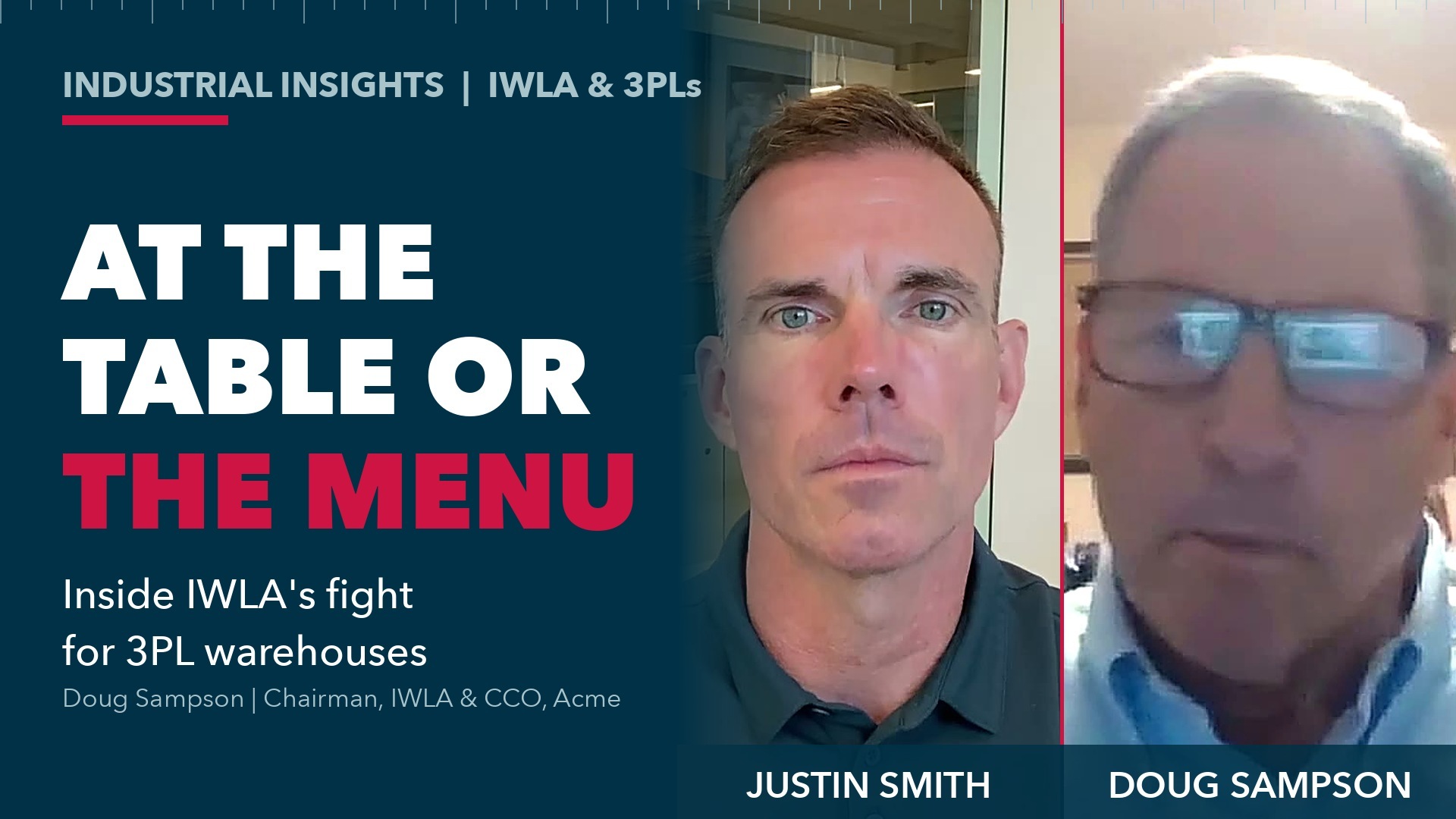
Why 3PL operators have to be at the table
Every warehouse in the United States shares a single federal NAICS code. That means federal and state rules aimed at giant e-commerce fulfillment centers sweep in regional third-party logistics operators working on 3-to-5-year customer contracts.
Doug Sampson, Chief Commercial Officer and shareholder at Acme Distribution and 2026 to 2027 Chairman of the International Warehouse Logistics Association (IWLA), joins Justin Smith to unpack IWLA's advocacy in Washington and state capitals, Southern California's Rule 2305 (WAIRE points at $0.85 to $1.20/SF/yr), Colorado's proposed 10,000 SF indirect source threshold, OSHA's proposed 80-degree heat rule, and 50 years of lessons in warehousing.
Jump to a chapter
Clips and episode trailer (15)
From Unloading Boxcars to IWLA Chairman
When 5.5M SF of Owned 3PL Real Estate Turned
Matching 3-to-5-Year 3PL Contracts to Long Leases
IWLA & OSHA: Keeping Warehouses Below 80 Degrees
Why WAIRE Points Act Like a $1.20/SF Warehouse Tax
The 7-to-1 Freight Rule when Regulations Push 3PLs Out
3PLs Are Not Amazon: The One-NAICS-Code Problem
Inside IWLA's Washington Fly-In: 450 3PLs in D.C.
How IWLA Standard Contracts Protect 3PL Operators
Fighting Colorado's Proposed 10,000 SF Warehouse Rule
30% 3PL Automation and the Data Center Power Crunch
Why the Age-21 CDL Rule Costs 3PLs Trucking Talent
Why 1-Hour Delivery Standards Never Go Backwards
Better at the Table Than on the Menu: IWLA's Mission
Episode Trailer: IWLA & Advocating for 3PL Warehouses
Conversation transcript
Justin Smith
Uh welcome everybody to the Industrial Insights Podcast. I have Doug Sampson with me. He's with Acme Distribution and IWLA. And we were just going through the story of Doug's career and uh in Acme Distribution. And it's interesting because it mirrors some of my experience working with a client that is a family-run uh logistics business and how that business evolved over the years. So I love
Justin Smith
If you'd continue, Doug, of how the early logistics business like uh and real estate like was uh package business and that was how people a lot of people like ran that business at that time and it's uh exciting because I've seen so many families end up owning a ton of real estate as a result, and then when the economy can get out of whack, that can be stability and like a port in the storm of not having to deal with landlords and rates and all of that. So
Justin Smith
I'm excited that uh part of your journey is been seeing that first hand.
Doug Sampson
Sure. So it's my pleasure to be here. Thank you for having me, Justin. Um, is as I was talking, I've uh been in the business about fifty years. And so I I got into the business as a part-time summer job unloading boxcars. And my father was really a commercial real estate guy, more on the financial side, but I needed to make some uh pennies to to pay for my way going to college.
Doug Sampson
And so I didn't know what the difference between a forklift and a you know a semi was at that time. I I got into the business and started unloading the boxcars and developing a high curiosity for why certain cases were designed in certain ways. And this goes to the packaging. And I'm talking back in the mid-70s. So at that time things were referred to as physical distribution management typically.
Justin Smith
Yeah.
Justin Smith
Yeah.
Doug Sampson
or you know the NCPDM if you will, way back then before it was CSCMP like it is today. Um so we got a lot of fancy terms for the same stuff. Uh basically so I I I proceeded to continue to go back and work every vacation, holiday opportunity in the warehouse just because I needed the money and uh instead of
Justin Smith
Yes.
Doug Sampson
I got these fancy schmancy degrees because accounting and economics and finance and marketing and I I just had the bug for what was physical distribution management and fortunately third party logistics, which means you have a lot of bosses and you're serving a lot of customers and I had no idea what what third party logistics was back then.
Justin Smith
Yeah.
Doug Sampson
So basically we were warehouses. We we were warehouses. Some people would uh refer to us as bonded warehouses, but it gets a lot more complicated is yeah. Public warehouses, yeah, storage and transit. And the business really developed, uh honestly, um, with the grocery business. So third party or public warehouses, uh the whole um
Justin Smith
I'd heard public warehouses was another term they would call, yeah.
Doug Sampson
origination of them was to act as a storage and transit and in loading place for boxcars of groceries. And so that's why you saw those initial w big bigger box and and when I say bigger box, I'm talking twenty to fifty thousand square foot kind of warehouses start to be developed as public warehouses as opposed to
Doug Sampson
the private or contract warehouses and and so forth. So the the advent of of that concept was great just with the timing in my life. So I I started uh instead of going into business with my dad, I said I'm gonna stay I like to learn a little bit more about why staff ships in certain ways, uh uh things communicate and so forth and
Justin Smith
Yeah.
Doug Sampson
And the founders of our business were very generous to me and and allowed me to make a lot of mistakes. And they for some reason they thought I was brighter than the average bulb and and uh gave me a lot of latitude. So at a very young age, I was I was able to play with clay and say, Why do we do this? Why don't we do that? And that curiosity still continues even to today. Um
Justin Smith
Yes.
Doug Sampson
It with the business models of of of where we were growing up back in the mid to late eighties, uh the family business, the public warehouse business was traditionally a family business and and that comprised the operation, the warehousing, the trucking, the there really wasn't a lot of fulfillment back then, but there was a lot, you know, just warehousing and most of it moved.
Doug Sampson
as we referred to is in bulk as opposed to we you know today you know you're taking things out of out of cases, out of bags, uh et cetera, et cetera. So it's gotten a lot more complex. But you had the operational component and you also had the real estate component. And so we the real estate component was meant to be a legacy asset that would transfer beyond all the generations. Um
Doug Sampson
de y depending upon what you charge the operating company as rents for. That's really you wanted to make money off the operation, but it was subsidized by the rents that were being charged as if through the ownership. Um and um so as as our business continued to develop, uh we made an acquisition in the late 80s um that
Justin Smith
Oh yeah.
Doug Sampson
was an another three companies that comprised uh at the time we were each about two and three quarters almost three million square feet so if you combined a total we were five and a half million square feet and we owned every square inch of real estate known to man and the business itself was centered primarily on CPG type of customers. So if you think about the large
Doug Sampson
guys that you would see every day now that's in a Walmart or whatever. That was our customer base. And it was not untypical to have one client taking up four to five hundred thousand square feet of space with just one customer. So we had some customers as small back then as small as maybe ten thousand square feet, but
Justin Smith
That's large.
Doug Sampson
most of the clients were of the larger size and and so there were compared to today much many less uh bosses if you will. Well as as computers and started to develop in in the late eighties and consultants and the ability to design supply chains started to come about. Many of our customers were being approached by these
Justin Smith
Yes.
Doug Sampson
Consultants saying, hey, we don't know if your warehouses in X City are the right place. How about you let us do an analysis for you and we can tell you where the best place to locate your warehouses at the time were? Well, uh the founder of our business, uh Jack Grunwald, uh he was not real excited about growing outside of the Denver market at the time.
Doug Sampson
And so we ended up um having the opportunity and declining to to set up locations all across the country because the the customer base loved what we did as as a business, wanted us to grow with them and Jack felt uncomfortable about wanting to make that jump into other cities and locations. So you you y in in acme world as we continue to progress.
Justin Smith
Yes. Yep.
Doug Sampson
Um, y you had customers leaving and and as you mentioned earlier, the real estate is a great asset. It's a great asset as long as you can release it on the open market. And back in the late eighties and early nineties, primarily in Denver, Colorado, it was like asking somebody if they wanted cancer.
Doug Sampson
So so the ability the ability to lease that building, we were in a depression, which is why we built the brine you know, back then in ninety five built DIA. But um so getting rid of the real estate was very difficult. We had to do some tough uh workouts with with the banks and because of the financial side, but we were able to recover.
Doug Sampson
And then we started taking a little bit of a different uh approach to expanding not only beyond CPG but also in geography. So af after the ACME story is then we started expanding all across the country. We were able to get some of some additional clients in different verticals.
Justin Smith
Okay, yeah.
Doug Sampson
ACME today operates over four hundred and fifty customers and probably eighteen different verticals. So you think about you had the CPG as one vertical, now y you know, so your your breadth of knowledge has to be really diverse and also there's a lot of attorneys out there, so you better be pretty confident in everything. So so we ended up with our initial expansion, we went across the country, went um
Justin Smith
Okay.
Doug Sampson
with Chicago, Dallas, uh, Harrisburg, Pennsylvania, Charleston, South Carolina, LA, and did some national programs and really kind of got on the map with at that time it was an electronics business. And so we we managed all of the transportation, we managed all the warehousing, we were managing inventory, we were manufacturing.
Justin Smith
Okay.
Doug Sampson
for the customer in and of itself. We we really expanded just we kinda we I wouldn't say we were over our skis, but boy, we were certainly getting bounced around a little bit by taking those jumps. And I'm really glad that we did. It um was was a great opportunity. Um is is you're aware, third party logistics people typically don't get
Justin Smith
Okay.
Doug Sampson
very long-term contracts with their clients. So to get a a 10 or 15 year contract is extremely unusual as opposed to most 3PL type contracts are three, five, seven type years. And so the the lease negotiation for what you need and and then making sure that your contract, your customer contract,
Justin Smith
Yeah. Yep.
Justin Smith
Yeah.
Justin Smith
Yeah.
Doug Sampson
in your operating agreement make sure that hey if the bottom falls out you're covered basically covering your rents and what have you. So so we ended up expanding, doing all sorts of different things. We started doing fulfillment. Uh this again is back in the early nineties. And if to do that we we also needed to learn a lot of things. I mentioned that hey we're manufacturing. Well you know
Justin Smith
Yeah.
Justin Smith
Not surprising.
Doug Sampson
Other than our desire to want to do it, we needed to get some some knowledge. So uh there was uh an association back then called Apex. And Apex was really this the uh today it's called the Association for Supply Chain Management, supply management, pardon me, but back then they were the American Production and Inventory Control Society. They they would basically give you
Justin Smith
Okay. Yep.
Doug Sampson
education exactly on how you need it to run a continuous flow production line or just all sorts of things where we gathered our knowledge, transferred it and put it into place, um and not knowing a thing about, you know, we all became modified engineers uh just because you had to. And and um that's the other, you know, it back then third party logistics people, logistics people, pardon me.
Doug Sampson
We wore a lot of hats. So y you know, you're dealing with people. So, you know, as an owner sh in ownership or or plant management or what have you, you still have a lot of hats to wear and we all didn't have just one hat and do one thing. The the business back back in those days was uh you know, you you you worked long hours and did a lot of different things. So so that's really the base.
Justin Smith
Yeah.
Doug Sampson
For how we became ACNE. Today we we've since sold those operations and we we operate in a couple other geographies, other than Denver is ACNE's primary location with about two and a half, three million square feet. And then we operate in the northwest and also in the northeast. So um with that, it's kind of a nice footprint. Um
Justin Smith
Okay.
Justin Smith
Yes.
Doug Sampson
with our existing client base. We've got a couple other things that are in the works for some other locations right now. So and with that I'll I'll kind of jump over into IWLA if that's okay, because some of the the the education that um we also get, I mentioned the the Apex Group or Association Supply Management.
Justin Smith
Yeah.
Justin Smith
Yeah, that'd be great.
Doug Sampson
IWLA has been around since eighteen ninety-one, and early on we we have always been members, but really started getting into the crux of what was going on at IWLA in terms of the education that they can provide, the advocacy that they can provide, and and so forth. So probably in the
Doug Sampson
Uh late eighties, early nineties, we became vi a lot more, myself personally, a lot more involved in this. And and they have some great educational materials uh for anybody in third party logistics from uh basically what we call essentials of warehousing, all the way up uh pricing, how do you price your goods, you know, your services, you know, fulfillment is different than this.
Doug Sampson
And then as you look forward to today's day and age, with the election being tomorrow, advocacy and and the effect of of who we put into office has such huge ramifications for us as an industry. And and when I say us as an industry, I would say probably sixty percent of third party logistics companies have their own trucking fleet. I'm gonna
Justin Smith
Yeah.
Justin Smith
Yeah.
Doug Sampson
you know, the fulfillment companies maybe not as much, but there's all sorts of things from that we look at legislatively. Um at a at a high level, let's go to Washington, you think about in California, the OSHA proposed heat standard. So buildings weren't built to be able to contain a temperature, you know, below eighty degrees when it's in the middle of summer.
Justin Smith
Yeah.
Justin Smith
Yes.
Doug Sampson
go to Dallas, Texas or or Baton Rouge. That doesn't happen. So being able to modify these buildings to accommodate for this legislation becomes extremely expensive. And is there it and and more so is is there a proper benefit to the employee? So and I think there's a lot of different opinions on that. And I'll I'll just leave it at that, but
Justin Smith
Yeah.
Justin Smith
Yeah.
Justin Smith
Yeah.
Doug Sampson
When you have things like an OSHA standard that may or may not be applied in certain areas and and and it's irregardless of the construction of the facility for for example, you know, sometimes the the the regulation will go as far as saying you will have certain conditioning equipment in the building. Well, it may not need it, but you still may be required to do that.
Justin Smith
Yes.
Justin Smith
Yeah.
Doug Sampson
probably some of the other things that are affecting us as an industry are um is as you're very familiar with the the South Coast Air Quality Board. And so the in w it's referred to as an indirect source rule. So the the governments have have basically said we we believe that trucks are the sole source or not the sole source but
Justin Smith
Yes.
Justin Smith
Yes.
Doug Sampson
a major contributing source of our pollution and we want to um incent them through punitive and tax ways to basically get rid of the old diesel trucks which are ninety nine percent cleaner today than they were in nineteen eighty. That's how much the the the combustion engine has improved through it
Justin Smith
Y yes.
Justin Smith
Totally.
Doug Sampson
uh legislation but but just other things. But um these inter source rules are
Doug Sampson
being applied to folks from Colorado, New Jersey, um, ah of course California and maybe now the entire state of California are being applied where where by there's an um uh a way that the the business say it's my business I have to track where the truck came from how many miles it was and presuming it was a diesel truck
Justin Smith
Yeah.
Doug Sampson
keep track of that. When product ships, I have to do the same thing for an outbound truck. And and so there's offsets and and the program has points. They're called where points. And I'm actively involved in in similar legislation, I should say, that's in in Colorado right now, uh that's that's basically a copycat of of the
Justin Smith
Yes.
Doug Sampson
South Coast program. And those those where points basically say, hey, there's going to be a certain fee that's going to apply because you're polluting the air, because you're not using uh non-emitting ways of getting those trucks in and out of your facilities. And there's offsets for certain solar panels on your buildings and what have you, but the
Justin Smith
Yes.
Doug Sampson
It's it's not the right way, at least in in my opinion, it's not the right way to solve the problem because we can't electrify. We don't have the infrastructure and the capacity to build enough trucks in order to actually have the right effect to clean the air. So what you have is this uh substantial tax
Justin Smith
Totally.
Justin Smith
Yeah.
Doug Sampson
Which is equivalent to anywhere from eighty five cents to a buck ten, a buck twenty per square foot per year of additional fee that is unfortunately passed along to the client and s and then the customer, the ultimate customer, because that's a cost of doing business. And then as warehouses get analyzed for location.
Justin Smith
Yeah.
Doug Sampson
Those indirect source rules are then also figured into those costs because just like Southern California, well, we've seen a a uh pretty large expansion in Reno, for example. Hey, I don't have to mess with this, I have the additional transportation cost. And one early on growing up, we all learned one of your basic rules was a transportation dollar is typically
Doug Sampson
seven times more than a warehousing dollar. So for every dollar you spend inside the four walls, you're gonna spend seven dollars moving it somewhere. Um that's changed, that model has very much changed now, especially with e-commerce. And you know e-commerce when I we were just starting was one or two percent of of our retail economy. And e-commerce today is
Justin Smith
Yes.
Doug Sampson
going to be about twenty three to twenty-five percent of is in and so is as is a industry uh we we've had to change and modify because not only do you have to fulfill it which gets a lot more complicated inside the four walls, but now you have to get it there and more importantly, you gotta get it there uh like in an hour or at the very most
Justin Smith
Oh yeah.
Justin Smith
Yeah. uh
Doug Sampson
tomorrow morning. So, you know, is is is um as a consuming public, you we we've all we like the convenience. We love the convenience, but um it does play a a big proponent in where where these warehouses are being located and what the you know the infrastructure of the of the delivery system happens to be.
Justin Smith
Yeah.
Doug Sampson
whether it's into a manufacturing facility, uh e-commerce supported, whatever. So um but anyway, I'll I've been talking here for a f a few minutes. I'll uh bounce it back at you and let you uh throw a few more questions or what have you.
Justin Smith
Yeah, that was a fantastic primer and you hit a lot of the important ones. It's always been a little goofy with the wear, uh, indirect source rule of having that go through landlords and then to the business. That's always been one that's kind of interesting that like if the business forgets to file it, like the landlord gets a notice and the landlord's gotta tell their tenant and then the tenant's gotta take care of it. I always thought that was uh
Justin Smith
little bit backwards, you'd think it would just be connected to the business itself and then the fact that it's also tied to the size of the building. So if you're in a ninety nine thousand square foot building versus a hundred and one thousand square foot building, you are or aren't uh participating in that rule. So uh it is interesting to think of is i that in any way helping solve the problem or is that just another method of like a taxation
Justin Smith
uh to some extent. But I'd be curious. Uh you go to Washington, you deal with uh Washington in some legislation. That's a lens I would think few people have, few people have that experience. Maybe that's good, maybe that's bad, but I was curious to understand what that's like, because that's uh uh gives you some good visibility connecting with people that try to deal with that and uh see what your experience has been.
Doug Sampson
Yeah. Okay.
Doug Sampson
Yes, I I'm very lucky that um I I think I'm lucky to be able to get the opportunity both to uh lobby for our industry at the state level. Um so I'm a past chairman of our of our ATA state affiliate and I still go down to the state and testify on proposed rules, regulations and what have you, as well as meet with regulators at the state level.
Doug Sampson
Um, one of the huge attributes of IWLA is its ability to access Congress, Senate, um, OSHA, uh National Labor Relations Board, because of all these rulings that are coming down that are affecting our industry, most of the regulators don't really understand.
Doug Sampson
the third party logistics industry were grouped together with Amazon. And um there's uh I'll give an example. OSHA has this national standard um that is really piloted against warehouses in general. And it was really meant as as a way to react to some of the incidents that were being reported in Amazon warehouses, but they're affecting
Justin Smith
Yes.
Justin Smith
Okay.
Doug Sampson
everybody because unfortunately there's only one next code for warehousing and we've tried to one of the things that we've tried to do is say um there's a difference between what we do as a third party logistics industry than I think what you're targeting at. And we'd like to propose getting a an an identifier that says hey this this is a third party logistics business
Justin Smith
Yes. Yep.
Justin Smith
Yeah.
Doug Sampson
they're contracting, you know, their services for other companies, blah, blah, blah. Um, we weren't uh fortunate to prevail in that particular uh situation, but I do go to Washington. Um I'm in Washington quite a bit just because I also sit on uh a board of the Surface Transportation Board. It's called the Rail Shipper Transportation Advisory Board.
Justin Smith
Yeah.
Doug Sampson
And we advise the STB board members, and this is primarily for rail um if rail freight and related issues that have to do with service pricing. You've probably heard about the proposed merger between the Union Pacific and the NS of of which I'm not allowed to say a word on.
Justin Smith
Okay.
Justin Smith
Yes.
Doug Sampson
Uh so um but it is out there, everybody's got their opinions, but I'm not only does that that board meets quarterly, but then IWLA I'll back up and IWLA does a fly in where we try to get many of our members to have the experience to go see your congressperson, to go see your senator.
Justin Smith
Yeah.
Doug Sampson
And and we have a very strong for us as big of an association as we are, we say we fight well above our weight because we get meetings with folks that many other associations just aren't successful about doing. We got a a very good partner in government affairs that that we utilize and and they have uh a way to get us a meeting. So your meeting
Doug Sampson
face to face with your congressman. Um your we set up rooms yeah out in Washington and typically we stay there a couple of days and and do as many visits as we can and and we we try to figure out what the right subjects for the right uh uh people were visiting. So for example, when
Justin Smith
Love it.
Doug Sampson
we visited OSHA, we wanted to understand more about some of the new OSHA rulings. Again, the warehouse emphasis program, that how does this work? And we we had a meeting with with the deputy director of OSHA and we we made miles of progress in in for him, educating him on where we were coming from. And we were so far off his radar
Justin Smith
Love it.
Doug Sampson
that it was it was really it was great. And so we we have actively engaged as IWLA to involve OSHA in in making sure that hey these communications, these um these concerns from an OSHA governmental perspective are are shared with us because we're we're really an association of of members, there's of warehouses, there's
Doug Sampson
450 members uh of public warehouse companies or third party logistics companies. So there's not that many of us as an association, but they love having the intimacy to deal with executive operational management to say, well, this is what we're seeing in in here. Or you they'll set up meetings with regional directors for you. So if you do have
Justin Smith
Yes.
Justin Smith
Okay.
Doug Sampson
Some questions, you you rather than just have uh an incident or an event and an audit and have everything in a in a pejorative standpoint, you're more proactively saying, okay, if we do this and this and this, how does that make sure? Do you have any concerns over this? Are we doing the right things to protect ourselves and our employees?
Doug Sampson
And i are we all happy or what what else needs to be done here? So that proactive communication has has been it's it's been music to our ears, especially this last year. Our our next fly in is in February and um it although we do stay in touch with many of those same folks day in and day out. I mean, there there's certain concerns that hey if if some
Justin Smith
Yeah.
Doug Sampson
If there's something that's come up, um will we have an active group that that will send notes out to each of our legislators respective, depending upon where you reside. And and then you know you can state your hey that we're for this or against this because of X or because of Y. And so the association has gotten really, really good.
Doug Sampson
about advocating for the industry.
Justin Smith
W w w the power of advocacy, how cool is that to make a difference and to get on the radar and to have a two way conversation and when you think of the alternative of uh if you didn't have that to feel like you weren't making an impact or that you didn't have an active seat at the table trying to figure out what the regulation might be or what the rules of the road would be for your own industry.
Doug Sampson
Okay.
Doug Sampson
Yeah.
Doug Sampson
Yeah. I I would go on just from an IWLA perspective. One of the things when I first started getting involved, I took a a liking to the the legal side, the legal and insurance side of our business. And and so there's there's still many companies that have operating agreements that are either uh that that they just don't apply, that's old
Doug Sampson
regulations, there's old and one of the things that the association does is it constantly updates, um, and I I'm fortunate to sit on the committee that updates its contracts so that we as a group can make sure that we're protecting our assets um in in tuna the best that we can and and you can probably translate that into the number of
Justin Smith
Okay.
Doug Sampson
lawsuits and so forth, we've recently out your way, there's been a couple pretty major warehouse fires, for example. Uh so you know oh uh and and so you can think about the number of suits and and the number of attorneys and so the although um there's still way too many attorneys to protect every contract to to the uh um
Justin Smith
Yes, there have been.
Justin Smith
Yes.
Doug Sampson
the degree you want it, um, the ability for you to have a very solid stance knowing the industry is promoting a certain set of of perform you know, criteria that says, hey, if then this and and in and typically most people don't think about something again in third party logistics if you if you
Doug Sampson
lost it or broke it, well there's a claim situation for whatever it happened to be. And and so these contracts, if they're properly written, spell out what what the desired outcome will be. And and there's ranges again, there's um there's there's lots of openness uh for ways to resolve that. The most important point is that you address it in in the
Justin Smith
Yes.
Doug Sampson
contractual relationship with your client, uh, so that it's it had it, you know, again, what if something's not defined, it it gets really difficult, whether through arbitration or case, if if now all of a sudden the monetary value and or a potential punitive or consequential damage can be added into a a specific situation. So um
Doug Sampson
Sorry to digress into one of the other IWLA attributes.
Justin Smith
Yeah, I love it. In our world we have AIR lease contracts and they're the boilerplate that most private parties use of and like we're talking from a million to ten million to a hundred million uh like a size of deals. And then you have the institutional grade contracts that are drafted by big law firms and uh
Justin Smith
Uh it's always interesting to think of the AIR boilerplate saves everybody so much time, so much money, everybody's so familiar with it. It may it's a balanced contract and it's something that has proliferated through the industry so that it's not for all deals at all times, but it probably covers ninety percent of all
Justin Smith
private party transactions and it's just a way that like everyone has become so familiar with it. You would sign it as a landlord, you would sign it as a tenant, you would feel very comfortable with it, and then it saves so much time, so much money, so much effort, and just like is has an ability to speed up and like grease the wheels of commerce while still like protecting everybody and it's uh updated regularly, but we're talking like once every five years or something that's far enough where
Justin Smith
You're not always worried about which version you have and you always feel pretty good and you can customize the hell out of it if you really need to or want to. But um that's uh reminds me of that just 'cause that's an example we have in our industry that we're all very thankful for and it it like uh helps create a lot of opportunity that might have gotten gummed up in uh red line comments and back and forth and kinda just like expensive uh legal fees that sometimes are necessary and then sometimes are not necessary for sure.
Doug Sampson
It it makes me laugh just 'cause as I you know, early in my career I think some of our lease agreements were five, seven pages. Maybe compare that to to to to your agreements. But but again, the it's necessary uh which is also why you need to be engaged in your in your government advocacy, whether it's an ordinance, a tax, a fee,
Justin Smith
Yes. Oh. Totally.
Doug Sampson
you know, a state regulation, a federal regulation, or what have you, all of that trickles down into what's gonna happen should this occur in your Reese Agreement, your operating agreement, whatever. And if you don't if you don't know, you don't know. I I love that saying, hey, we just don't know what we don't know. Well you need to be proactive uh if you're gonna be in the business at any level.
Doug Sampson
You owe it to yourselves and your employees to make sure that you're doing your best due diligence to make sure does this is this something that concerns our business? And if so, what are we gonna do about it and how is it negotiated through the transaction? So yeah, it's uh
Justin Smith
Yeah, that's uh uh so true. And then once you know then uh you'll never forget it, 'cause it left a big mark on you. uh
Doug Sampson
That's that yeah, it typically only takes one, that's for sure. Um it it's funny, I I will go back to the indirect source thing for a quick moment. In in Colorado, the proposed you were talking about a hundred thousand square feet being the cutoff of the existing model. Uh the proposed uh regulation out in Colorado is ten thousand square feet. So think about
Justin Smith
Yeah.
Justin Smith
Okay. That's pretty much everybody.
Doug Sampson
incumb that's pretty much everybody and and it it think about uh sports venues so it includes sports venues the airport um it it's gonna be a heck of an encumbrance for all these companies that don't have the resources anyway to be able to track all of this activity that they're in addition to everything else they're doing. So um in and
Justin Smith
Yeah.
Justin Smith
Yeah.
Doug Sampson
We're we're trying to get some latitude in modifying that, but we have not yet been successful to try and at least get it back up to where South Coast is. Um it
Justin Smith
Yeah, employees with at least a hundred employees or fifty employees or at least doing ten million or hundred million or other ways of measuring it that can make sure it's not like uh
Doug Sampson
Right, right.
Justin Smith
Uh I would imagine other topics maybe is our final topics knowing what time it is. I would think uh labor and or technology would be uh two that are top of your members' lists if I were guessing. I don't know if one of those two is a bigger uh topic than the other, but I would think uh that's on everybody's mind. Like labor is perennial and then technology I feel like has been such a pronounced
Doug Sampson
Yeah.
Doug Sampson
Well.
Justin Smith
part of the last year of like further adoption and further like insight as to what's possible and uh so I would think you guys would talk about both quite a bit.
Doug Sampson
Sure. That's um uh w is is an association and as a business. These are daily conversations. Um there's there's so much cool automation out there, you know, some of it is, you know, toys for the toy box, but some of it is being readily used. And and the last statistic I read was I think it's bumping up on almost thirty percent.
Doug Sampson
uh third party warehouses uh or warehouses in general have some type of fixed or flexible automation that they're currently using in their facility. And when you're thinking about in the real estate side of the business, this is likely only to grow. And so you know we still have the human component, but the infrastructure
Justin Smith
Okay.
Doug Sampson
the power, for example. The data s centers have affected the real estate business. It's and will continue. So once we figure out which areas want data centers or don't want data centers, if there's a data center going in, it's going to have a profound effect on the supporting infrastructure for those companies supporting the data center from an automation standpoint.
Justin Smith
Yeah.
Doug Sampson
You know, hey, somebody's gotta fix the HVAC, somebody's gotta and there's parts that supply warehouses, et cetera, that will will be needed relatively close for these people to continue to operate. Um so th on once that's all shaken out, th there's some, you know, you've got high end manufacturing real estate that we are not a part of. We like to look at it and it's pretty cool.
Doug Sampson
Uh I know many third party logistics folks that have we have some automation. I know folks that have end-to-end automation in certain facilities where it's robots, et cetera. Um the the key component needed to run, regardless whether it's robots, autonomous vehicles, conveying or whatever, there's still a people component required at every level.
Justin Smith
Yeah.
Doug Sampson
And keeping attracting and retaining the highest and best is critically important to our industry. Um and and there's not a lot of people that want to get into if you look at the typical eighteen year old career path right now, they either want to go to college, okay, and they're upset that AI's may replace their you know perceived career path.
Doug Sampson
there or they go to a skill trade. And so you don't see a lot of these, you know, hey, when we can get a truck driver's license, maybe at 18 they'll be more successful. But by the time uh uh you can get your CDL at 21, now you've kind of missed that gap. Those three years are very important as to how do we attract and maintain
Doug Sampson
Because remember the supply chain's not just what's inside the four walls, you still gotta get it there. And and as the the many issues affecting the trucking side of of supply chain are, you know, we we've got I I won't go into all you know between English language proficiency, um, you know, domicile drivers. Um there's been uh the capacity in this market
Justin Smith
Yeah. Yep.
Doug Sampson
is kind of going like this. And now we're kind of back on an upswing where opacity is a little bit tighter. And and so where is it going to be next year? I wish I could tell you. The diesel prices have had a huge effect on on those businesses. But when you think about the end result, you and I are ordering something
Doug Sampson
Again, we're we're part of the thirty percent that want something in our doorstep in an hour. And in order to do that, that infrastructure really needs to be expanded and and be there in order for that to occur. Unless we change our value system as a consuming public, and you know, I don't know if somebody's going to break the one hour barrier. I I suspect it will happen.
Justin Smith
Yes.
Justin Smith
Yep.
Doug Sampson
But but but quite frankly, when s when I first heard of the one hour delivery, I giggled to myself. I said, Do you really need it in an hour? Is it that important? And and you look at what what pressure that puts on every supply chain that it's that that's trying to observe the mirror. And and that's why the proliferation of uh of e commerce warehouses
Doug Sampson
in in the universe of commercial real estate, you know, w what what percentage is e commerce warehouses? I know third party is any depending on who you ask, anywhere from twenty to thirty five percent of all the blocks.
Doug Sampson
box is is third party e-commerce gets mixed in sometimes with third party logistics. And so that I know that sector has really increased uh exponentially in the last ten years. So and and again, the only way to get it to you within your one hour or one day is have it have it much closer to you. And you know, we've got a lot of geography in these United States, so
Justin Smith
Yeah.
Justin Smith
Yes.
Justin Smith
Y yeah, it is funny to think of uh what
Doug Sampson
As far as employees Yeah. Yeah yeah. Oh go ahead. I apologize. I had a uh a break in my s connection.
Justin Smith
Oh, no worries. The uh how convenient do you really need everything to be? And on one hand, rarely do you want less than what you're accustomed to. And on another, of course, there's like a practical balance. But um uh while one hour may not be necessary for everyone, it's hard to imagine one day turning back into one week, no doubt.
Doug Sampson
Yeah, that I totally agree. It's very difficult to go backwards. Um it's it's kind of like once there's a tax in place, it's it's pretty odd that it's gonna go away. So you don't want the tax if you unless you're really willing to live with it. So Yeah.
Justin Smith
Yeah.
Justin Smith
Yeah. Well I'm sensitive to your time, Doug. I do appreciate ya spending time with me today. And uh I love getting to learn more about the ACME like a trajectory and most importantly your story and your growth through it and uh learning like how well you have become an example of a steward that's excited about their industry and is thinking about advocacy.
Doug Sampson
Yeah.
Justin Smith
and thinking bigger than just you and your company and I'm sure that's a super fulfilling to be able to serve the greater student body and then uh to help bring more resources and more visibility has got to be a pretty rewarding w like uh venture.
Doug Sampson
Yeah, we we're excited about what's happening. Um certainly they're at us from uh you know with the elections coming up and so forth, but it'll be that way forever. We we've it these are not new issues. We've been battling and promoting issues for the last twenty years, thirty years. Um we'll be doing it till the end of our lives, likely. Um so
Doug Sampson
Uh is as the old adage goes, it's better to be at the table as opposed to being
Justin Smith
Ha ha.
Doug Sampson
on the menu. And oh that's you know, it hey, I I may not have been successful, but at least I gave it my all and we're trying, so
Justin Smith
Yes.
Justin Smith
Yeah. I love it. I love every minute of it. Thank you, Doug. I appreciate ya. Appreciate talking with ya and excited to learn more. And then uh I have as you'll see on my calendar over here, uh
Doug Sampson
Thank you, Justin.
Justin Smith
Yeah, I have uh l this year and next year's events I always plan out in advance. And I've been trying to get some of these uh events that you guys host on the calendar for next year 'cause there's so many good ones that I feel like would be applicable on good learning opportunities.
Doug Sampson
Well, I'll I'll put in a little plug. Our annual convention this next year is at the end of April, going into May, uh in Puerto Rico. So it's uh it and it's gonna be an awesome educational uh event as well as in one of the most beautiful resorts. It's called the Conquistador Resort. Um so you know, take an extra couple days with your family uh and make a mission.
Doug Sampson
and and learning experience out of it, but um we're excited. The the um the excitement is very high. We've got a great uh pre registration already going on in place where you know I'm sure it will sell out well in advance of of the due date, but um and and as we talked earlier, real estate is a huge component of why we all exist. So um
Justin Smith
Yeah.
Doug Sampson
You know, we'd we'd love to have you there.
Justin Smith
And uh warm weather and nice blue water never hurt either.
Doug Sampson
You know what? It d it doesn't hurt. That's right. All right.
Justin Smith
Right on
Justin Smith
Yep, thank you, Doug. Take care. Talk soon. Yep, bye bye.