Industrial Insights · Prologis Research
Leading Prologis Research with Melinda McLaughlin
Listen to the full episode
Inside the research
What can a global logistics real estate platform see before it shows up in a quarterly market report? Melinda McLaughlin joins Justin to explain how Prologis connects customer behavior, supply-chain research and local market feedback.
The conversation moves from AI and warehouse automation to the logistics behind data-center construction, then turns to Southern California: how large transactions move the statistics, how transportation costs influence location, and how to separate cyclical weakness from structural change.
Five ideas to listen for
- Supply chains shape a company’s reputation.Speed, reliability and the customer experience make logistics a competitive decision.
- AI can help smaller companies compete.Melinda discusses the opportunity for nimble organizations and the pressure on large incumbents.
- Automation changes what a warehouse needs to do.More throughput and mobile systems can change space requirements rather than simply eliminate them.
- Data-center demand has more than one phase.Construction, factory assembly and recurring maintenance generate different logistics needs.
- Local context matters when reading market statistics.Large deals, operating costs and customer feedback help explain the Southern California cycle.
Read the Prologis research
Every report Melinda references in the conversation. Click a screenshot to open the original on Prologis.com.
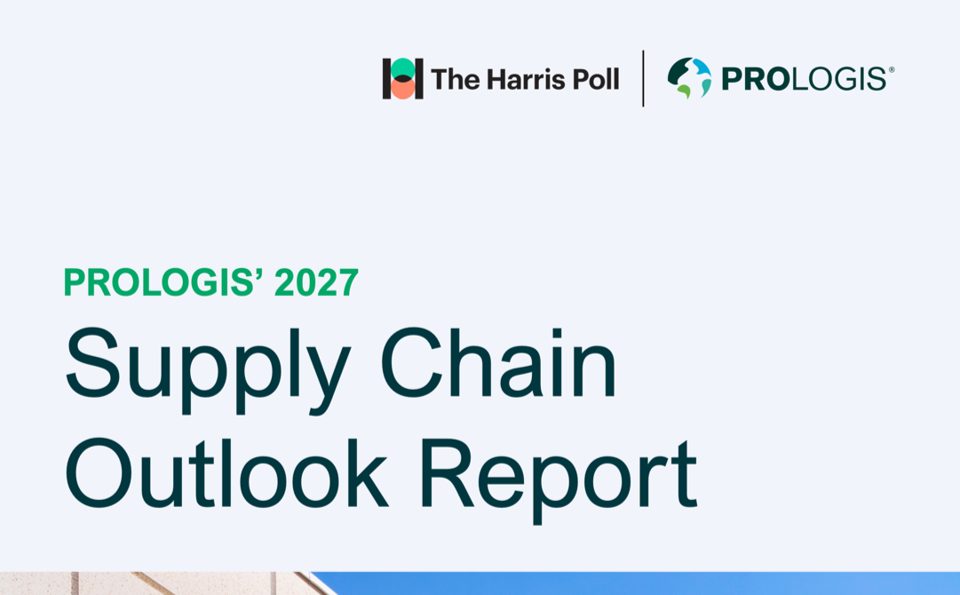
2027 Supply Chain Outlook
Prologis and The Harris Poll · October 2026
The survey of 1,821 supply chain leaders Melinda references when she says speed still wins market share. The AI adoption figures shown in clip 02 come from this report.
Read the full report (PDF) ↗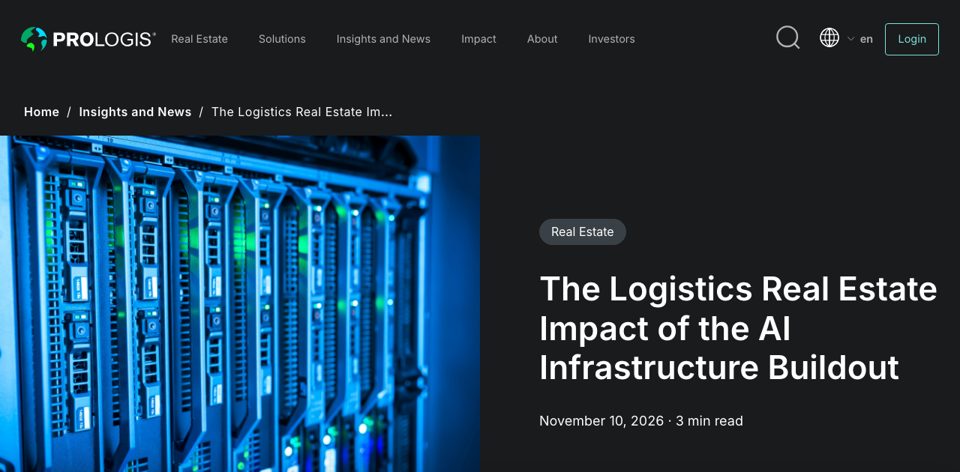
The Logistics Real Estate Impact of the AI Infrastructure Buildout
Prologis Research · November 10, 2026
The data center research Melinda describes in depth: why the construction multiplier cannot simply be trended forward, and why part of the logistics demand stays after the buildout.
Read the research ↗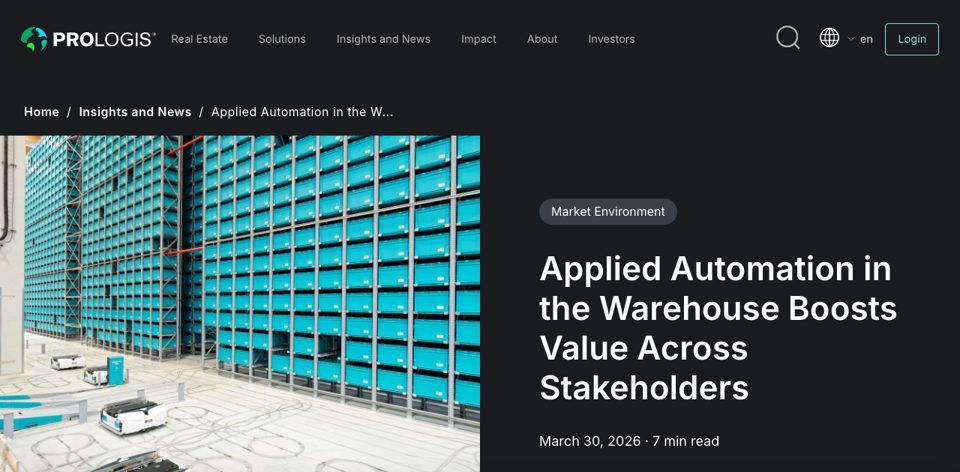
Applied Automation in the Warehouse Boosts Value Across Stakeholders
Prologis Research · March 30, 2026
This year’s deep dive into automation: mobile and modular systems, adoption since 2020, and why automation adds building requirements rather than removing the need for space.
Read the research ↗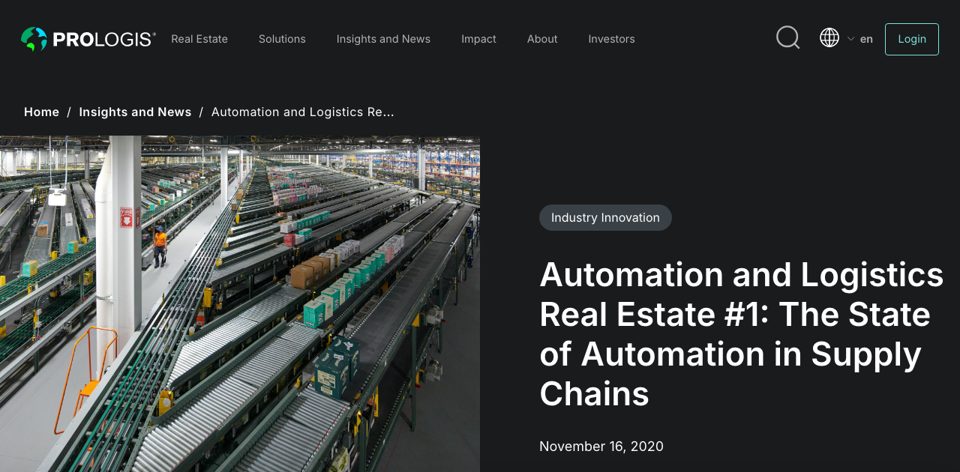
Automation and Logistics Real Estate #1: The State of Automation in Supply Chains
Prologis Research · November 16, 2020
Part one of the late 2020 automation series Melinda looks back on in the episode.
Read the research ↗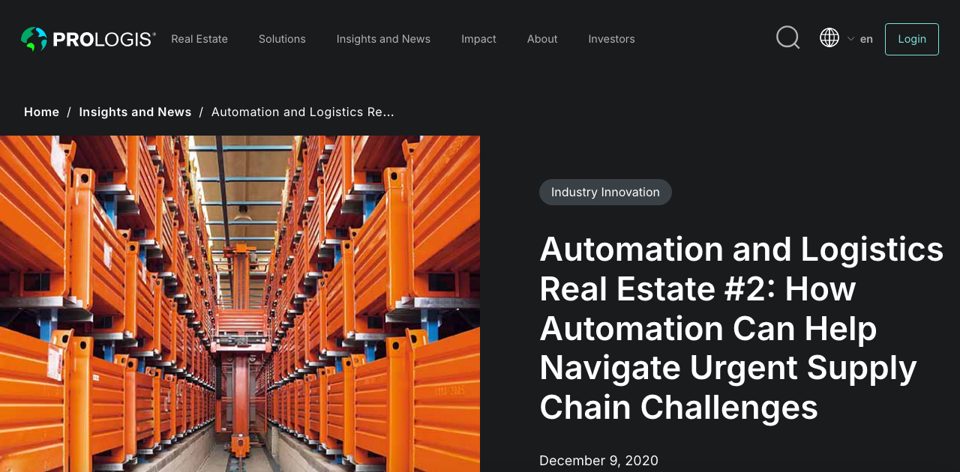
Automation and Logistics Real Estate #2: How Automation Can Help Navigate Urgent Supply Chain Challenges
Prologis Research · December 9, 2020
Part two of the 2020 series, with the predictions she says have largely played out: more adoption, mostly mobile and modular, and no loss of demand for logistics space.
Read the research ↗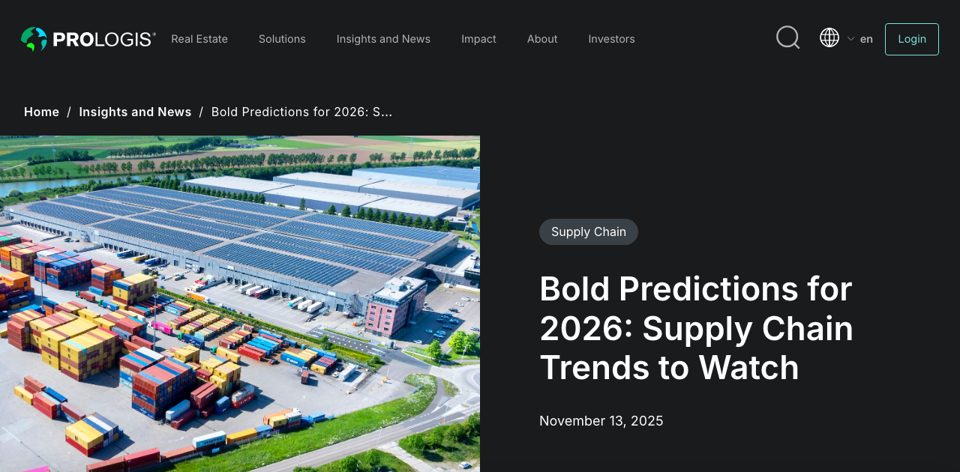
Bold Predictions for 2026: Supply Chain Trends to Watch
Prologis Research · November 13, 2025
The annual predictions paper Melinda mentions, including the call that transportation costs would start rising by double digits as excess trucking capacity dwindled.
Read the predictions ↗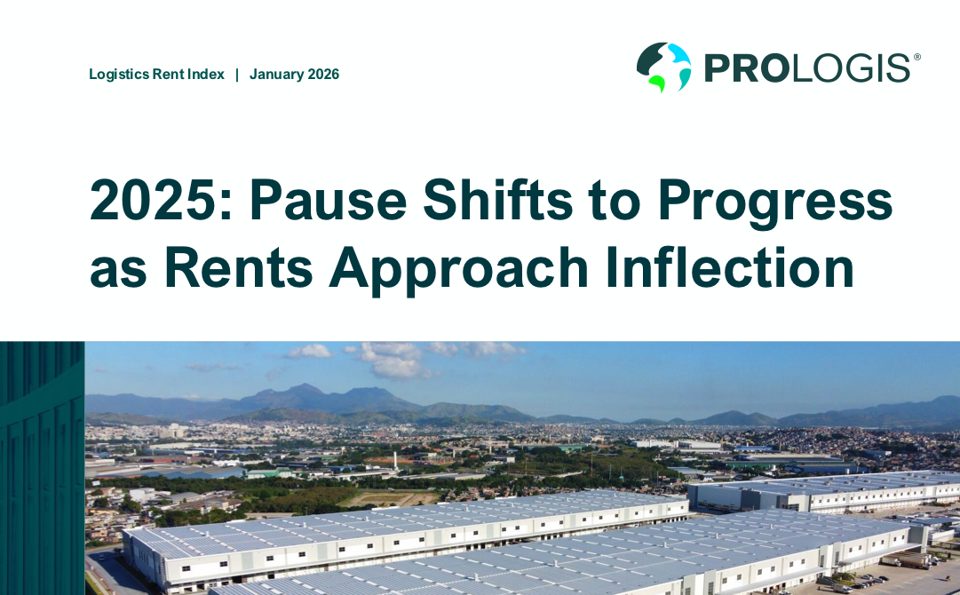
Logistics Rent Index: 2025 Pause Shifts to Progress
Prologis Research · January 2026
Background readingBackground reading for the rent cycle discussion. It covers U.S. and global markets, not Southern California alone.
Read the Rent Index (PDF) ↗A useful distinction: upstream and downstream
Upstream and downstream describe where an activity sits in the flow of goods. Upstream is closer to producers and suppliers; downstream is closer to the final customer. The reference point matters: the same warehouse can be downstream of a factory and upstream of its customer.
Upstream: toward the supplier
Think components, raw materials, manufacturing and assembly. A server manufacturer is upstream of the data-center operator that buys its equipment.
Downstream: toward the customer
Think distribution and delivery toward the end user. Moving finished equipment to the data-center site is farther downstream than producing its components.
Construction demand versus ongoing maintenance is a separate distinction about timing. Both phases can require inbound equipment, storage and delivery. Clips 07 - 09 explore those different sources of logistics demand.
Watch the conversation in 13 clips
Choose a topic, then press play. Each clip includes on-screen captions.
Supply chains are reputation machines
AI gives smaller companies a chance
Why big companies must stay nimble
Less China does not mean less Southern California
Automation can increase warehouse demand
Warehouse automation that can move
Data-center demand has a multiplier limit
Data centers are becoming factory assembled
The data-center demand that remains after construction
Why million-square-foot deals swing statistics
Southern California: cyclical or structural?
Transportation costs can pull demand back
How Prologis research checks the numbers
Jump to a chapter
Select a chapter to play that part of the full episode.
Episode transcript
Prepared from the episode captions.
Download transcript · Download captions
Read and search the full transcript
Justin Smith
Okay, welcome back everybody to another episode of the Industrial Insights Podcast. I have Melinda McLaughlin with me, of Prologis, who is their global head of research, and someone that I had spoken with who had helped me with my book back in 2020. I'm happy to have you back. And then this is a time during the recovery where I feel like this is a good time for industrial. And it's probably the hardest time to know what's really going
Justin Smith
on. Some places are booming, some have not recovered. And so I appreciate you spending some time and going through some of the nuance.
Melinda McLaughlin
Absolutely. Thanks for having me back, Justin.
Justin Smith
Yes. And then I had asked you about groundbreakers. For people who are not familiar, what is it?
Melinda McLaughlin
So Groundbreakers is our annual thought leadership conference where we really bring Together, I think, a lot of different functional areas of the supply chain, a universe that Prologis touches, whether it's through our venture group. So some of the cutting edge AI applications, technology, robotics companies, our customer business. So always, having some leaders who can give us that corporate perspective of how they're
Melinda McLaughlin
tackling some of the challenges out there. As well as this year, we added even just financing, right? Financing the AI boom, real estate, the investment in infrastructure and the supply chain. So it's pretty full-bodied, I would say, really coming from a number of angles, but leveraging those unique opportunities, we get to interact with some of the thought leaders across our worlds.
Justin Smith
It's cool having the venture aspect to it too. Then you get like another insight into who is helping these people grow and what is that likely to look like.
Melinda McLaughlin
Absolutely. I love hearing what. Is, I mean, ultimately comes down to problems needing solving and the solutions that are out there. And we had someone from sort of a modular nuclear reactor company, right, Really thinking about the power challenge and the way they're tackling it. Now, he cautioned that's an early 2030s type innovation, but we're laying the groundwork today and a lot of folks are leaning in to solve what is a major
Melinda McLaughlin
challenge.
Justin Smith
OK. Not seen that in a nuclear lease yet. I'd be excited to be one of the first to be like, Okay, what do we do with nuclear and how do we make that work for everybody?
Melinda McLaughlin
Yeah, right.
Justin Smith
I love this shift if we have supply chains from a cost center to a revenue generator, and then this was something new to me was the supply chain as a reputation machine. And I could totally see it when I think and reflect on that. And then I compare it with a lot of people where it's just cheaper, cheaper, cheaper, and like a small margin business. How did that come about? That's interesting to think through of like, how is it
Justin Smith
changing and actually name it?
Melinda McLaughlin
Absolutely. So look, there's always going to be cost pressure. I think in today's environment, inflation is still running hot. Consumers are still cautious with their spending. Businesses are investing, but they want to put money in the most productive areas. So I always say it's cost plus, and that plus has been growing as a factor in all the considerations for site selection, for example. Justin: Multiple pluses Multiple pluses. Justin: and bigger pluses.
Melinda McLaughlin
Yes, exactly. Bigger pluses, more of them. And it's how you see every challenge is an opportunity. So if you think about the cost center, the opportunity was to get business based on the lowest price, most efficiency.
Justin Smith
Yep. Melinda: Again, that's still a factor, but revenue generator was where we really started to see like e-commerce come into play. So you got market share because you were able to use your supply chain to deliver more goods on time, faster delivery times. That was a theme from our we did a Harris poll survey of supply chain leaders. You know, it's still all about speed. And so that allowed you as a retailer, for example, to
Justin Smith
capture market share. Now, today, that reputation machine is really about using your supply chain to competitive advantage. So if you take the cost angle, for example, An ability to navigate new tariffs or new materials or input cost surges is a competitive advantage, right? That helps your reputation. You can keep costs more constant for your ultimate customer. If you think about the ability to ensure goods even get into the
Justin Smith
country, right? We're not through the end of supply chain hurdles. So there's backups at the ports. Panama Canal is challenging again. Strait of Hormuz, Red Sea, right? Just the ability to say we can get this to you on time, effectively meet all of our promises. That's where the reputation comes from, and that's where we see more companies Driving their business. They don't just want the cheapest partner. They want a trusted partner who
Justin Smith
can balance all of these different factors. Yes, It's your ability to deliver despite all of those disruptions, which means you've thought Melinda: Exactly.
Justin Smith
things further out into the future, you can adapt better, you've played out multiple Scenarios, you have backup options, and so on.
Melinda McLaughlin
Yeah. And I think that, you know, one thing we, again, we dug into the survey, but One insight that was meaningful to me is that some of the new technology and tools out there are actually leveling the playing field. So there's always been a big company advantage, of course, more data, and that will persist. You know, data is the currency of today. But on the technology side, I think to invest in it, to have a team of data scientists,
Melinda McLaughlin
all these different things. AI is lowering the barrier to entry there. And so I think it'll be really interesting to see how smaller, more nimble organizations tackle challenges in the supply chain going forward. Will we see a growing disparity or will it actually shrink as some of these new technologies come into play?
Justin Smith
It's the best, right? I think it allows all the entrepreneurial types to be able to now play with the big boys to some extent or have the ability to chip away at some of the delta in between the two and actually gain meaning from it and have it lead to real results and better, bigger outcomes. Absolutely. Melinda: And I would say for our bigger companies, right, you have to remain nimble. The bigger as an org you get,
Justin Smith
sometimes the harder it is to pivot. I think you know there will be large companies who absolutely lean into this and are designed for it. But you know I would say if I were a bigger incumbent player, I would be really focused on this. Like how do we make sure we don't get leapfrogged by these smaller, more nimble orgs. you wouldn't think they'd be afraid of that.
Justin Smith
But it's a good thing to be mindful of.
Melinda McLaughlin
think we see a little of it in the survey. Just the things that supply chain leaders are now forced to think about is changing in real time.
Justin Smith
Yep. Legacy can be bad. As much as it can be good.
Melinda McLaughlin
Yeah. As I mean, we all, you know, we all study the case studies, the Blockbusters, the Kodaks. Nobody wants to be that. And I think, you know, when we have rapid change, that's, that's the time where you see disruption. Yep.
Justin Smith
A quick groundbreaker stage topic was China and how much we were like dependent upon cargo coming straight from China and into the ports of Southern California and how people have adapted and changed. And that ship has sailed to some extent and that people have adapted, changed. And then now we have a lot of domestic, like a growth opportunities. Is that, that's on your radar? That's something that's in your research?
Melinda McLaughlin
Yeah so we're we just published a piece on really the AI infrastructure build out has been part of that story. So some of the investment at home is really to support that industry, where there is a bit of a competitive dynamic, as everyone knows, between the U.S. and China. But still, frankly, a lot of imports even related to that. So I would say I always talk about advanced manufacturing and AI infrastructure as a Venn diagram.
Melinda McLaughlin
There is some advanced manufacturing that's targeted toward the AI infrastructure build out, but there's a lot of AI infrastructure that is import based now there's also a of
Justin Smith
And throw a little defense in there too right
Melinda McLaughlin
well that's the other advanced manufacturing, right? So there's advanced manufacturing that is not related to AI. So we're seeing the space economy defense, pharmaceuticals, really high value equipment. Even you know, segments of the auto supply chain continue to either be reshored or on near shored in Mexico. And again, it's adapting to what are new challenges. The fundamental hyper efficient single source of origin global supply chain.
Melinda McLaughlin
I don't think we go back there anytime soon. And so we see it in the shifts of where imports are coming from. And what I would say for Southern California, which I know is where you're based, is the change is less dramatic because it is really other Asia that's benefiting in a lot of cases. So while there is high value along the border in Mexico and that's shifting, the bulk of what's coming through the ports of Southern California is still coming
Melinda McLaughlin
from the Trans-Pacific trade route. So even if China makes up a smaller share, it's being more than offset by Vietnam, Thailand, Malaysia, some of these other areas where again the most efficient way to get into this country is through Southern California.
Justin Smith
Yeah, so that would tell you some major themes would still continue as a result.
Melinda McLaughlin
Exactly. Yeah.
Justin Smith
And then if that was a little peek into groundbreakers, when you just think of everything that's in your domain that's research related, I would imagine it's plentiful. If I just am familiar with like bold predictions and with utilization of inventory, of warehousing. What are the main reports that you like help contribute to are responsible for?
Melinda McLaughlin
Yeah, I mean we my team does everything that comes out of the Prologis Research org. So this year we took a deep dive into automation. I would say, the last time actually it's very similar to our cadence. The last time we took a deep dive into automation was late 2020. And we made predictions, right? we're going to see increased adoption. It's going to be concentrated in mobile and modular solutions, and it won't Effectively destroy demand for
Melinda McLaughlin
logistics real estate. And so when we look back today, more than five years later, effectively everything we thought would happen has happened. We're continuing to see automation adoption drive need for more space, actually, but also specific building requirements. It's not that every piece of automation requires a specific building, but it is part of the story with higher power requirements, things like that, as companies seek to not only
Melinda McLaughlin
accommodate the way we do things today, but the way we're going to do things tomorrow. So, really, that's more autonomous mobile robots, autonomous forklifts, shuttle systems. Taking one mobile and modular, I always say, is really about taking one activity in the warehouse and automating that. And those solutions are portable. They're flexible. They can be leased. And it's very different. Justin: Scalable. Yeah, it's very scalable.
Melinda McLaughlin
It's different than The big, like fully like dark warehouse type, where you can shrink a footprint if you do it that way, but it's very expensive. It's not flexible. It's you know, it just doesn't work for most customers. And so as I look forward, I would expect that to continue, right? Labor scarcity is not going away. The requirement for better accuracy, better speed, those aren't going away. And that automation is part of
Melinda McLaughlin
that. So that was our one first big piece of the year. And then the second I already alluded to is data centers. So we've seen this demand crop up, right? It's really it is geographically connected, right? You don't need to be next to a data center, but proximity matters. This is a lot of bulky, high value equipment. Sales tax regimes across state borders can be tricky. So Texas has been a beneficiary. Georgia has been a beneficiary.
Melinda McLaughlin
Arizona, California certainly, with the pre-existing AI industry presence here. And so really digging into that. And one thing I would say that maybe is different, I know we're not the only ones. And in fact, we were a little late to the game on this one because I wanted to understand it at a very deep level. We have an internal where we do data centers as well. So I could leverage the team there, the real lived experience,
Melinda McLaughlin
customer connections and the like. But I would say that the thing I think we tried to be really clear about that maybe others haven't is we're in the middle of a build out right? So the multiplier we see today between data center construction and logistics demand, it's not as if you can just take that and trend it forward. So I always say building a gigawatt today and building a gigawatt in you know 2028, you need the same logistics
Melinda McLaughlin
square footage to support that. It's not like you get double just because it's a year or two later.
Justin Smith
Sure. Melinda: And so it can be a really powerful demand driver. And it is. Again, these are big, bulky. And the other underappreciated factor, I'm really sorry, I'm very passionate about this. Get in there. Yeah, That's the top of mind. Let's go.
Melinda McLaughlin
Yeah. The other underappreciated factor is in, we've been building data centers, of course, for decades.
Justin Smith
Yep.
Melinda McLaughlin
But a lot of it when we were doing it not at scale, not at the scale we see today, a lot of it was customized. So you go to the site and all the fit outs would be, you know, really just handled on site. It would, a very bespoke construction process. With the level of build out we're seeing today, that's the reason why the demand multiplier is so powerful. Because more and more of that, what used to be on site and bespoke is now
Melinda McLaughlin
happening at scale. So really kind of Factory assembled modular solutions for data centers. So that's a new part of this as well. So what I think we'll see is just a lot of really powerful demand in the near term. And then it should scale. Now, few places we were pretty conservative on a couple things. One, you know, the hot spots today will probably remain the hot spots Now, if it migrates, you you do have to kind of set
Melinda McLaughlin
up a new supply chain in a new area So if we get more. Geographic dispersity, we could see upside. And then I think we were also pretty conservative on the just level of the build out right? Of course, there are new challenges. We just had the election, just you know, kind of physical requirements of how fast can you build infrastructure to support this. We see a longer, more sustainable pipeline here, and so that's going to keep
Melinda McLaughlin
construction-related demand present in these markets for five plus years. Again, when we have these leases signed, they look like all the other leases in the market. So I don't know how much you've seen in SoCal, but it's not
Justin Smith
Not enough.
Melinda McLaughlin
as if they're shorter term or anything like that, right? They're typical so even if you're a company that's more more benefiting from the building process rather than the maintenance we're gonna see very long dated demand there. But then Unlike other types of building where it might be sort of you build it and then you move on to the next thing, there is about half of demand that needs to be permanent because this, a data center needs
Melinda McLaughlin
to be refreshed every year, right? The technology, the electrical infrastructure. The old rule of thumb was probably once every five years, right? Rolling about 20% of your innards of the data center.
Justin Smith
Yeah. Melinda: If we think about the new uses, so how intense AI is, how intense quantum computing will be, That changes the servers you need, maybe the rack configurations, definitely the electrical and cooling infrastructure to support that. So we could actually see even more churn in that maintenance side of demand. So highly encourage you to take a look. We went super duper deep, but I'm really proud of it. Yeah, that's huge.
Justin Smith
And it's something that I think because it's like a new-ish it's or the in the version of it that is present today is ultra new that everybody comes to it with a beginner's perspective to some extent of like what is this all about and what don't I know about it. I know for industrial people, Melinda: Yeah.
Justin Smith
everyone thought that we industrial guys would know all about that. And then you quickly are like, This is not even close to what all of the logistics and manufacturing looks like. But I would think if more people knew that half of the demand is going to be permanent, that that would be something that would give people more enthusiasm for that infrastructure being built out, knowing that that's not just you build it, everything
Justin Smith
disappears other than the center itself, and people thinking about like the community and the benefits to the community.
Melinda McLaughlin
Absolutely. So, you know, there's jobs, right? There's jobs that'll be needed permanently as well for that maintenance, that servicing. And as the the stock of data center grows, the more again maintenance related demand you're going to have, that's permanent in that market.
Justin Smith
So what inning are we in? If you said five plus years, that Melinda: I would, would tell you, I'm not a math Melinda: I major, but this early day.
Melinda McLaughlin
it's early days. Yeah. I mean, at Groundbreakers, I think somebody said second inning, and that feels right to me, right? We, we are still understanding what the underlying driver, so the AI impact, we're still understanding how to commercialize that, how to use that to drive productivity. So the inference wave where you really put that to work. So even if I just narrow to our, you know, inside the warehouse, so there could be
Melinda McLaughlin
robotics Uses and to leverage AI, there needs to be low latency. And so how that comes to fruition is still to be to to be determined so I would say very early innings here.
Justin Smith
Love it. That's awesome. That would tell you there's someone out there making land purchases in markets that could be potential future expansion. And then it is interesting to think of how many data centers do you think you guys have built or owned compared to the 500 buildings in Southern California that are industrial? Would you say 10 or 100 or 1,000?
Melinda McLaughlin
Oh, very low, right?
Justin Smith
Yeah. Melinda: A data center is so capital intensive compared to a logistics building. So complicated, so complex. It's really, yeah, it'll be More money but fewer square footage than, of course, what we're used Oh,
Melinda McLaughlin
to in logistics real estate. Yeah.
Justin Smith
Last thing I would ask, because we're trying to keep it a little on the succinct schedule, would be Southern California. So if we've already talked a little bit about China and the change there, and then data centers and all of the demand that we think we'll see and we'll continue to see. And then Southern California being where Prologis owns the most real estate and the most industrial. I would imagine you get to spend some time like
Justin Smith
digging into all the stats. And it's wild when I go through all the reports and find they're all different.
Melinda McLaughlin
Yep.
Justin Smith
And some will show positive and negative net absorption of like half a million or a million or two million or five million in any direction. So I was curious, if you're a research wonk, how do you make sense of all that, Or do you just have your own methodology, and then those are just good things to take into account, but not to rely on?
Melinda McLaughlin
Yeah. Well, you put out some really good reports on the market. I know frequently, and I'm always taking a look at those. But I think the main thing is to try to absorb everything. And then we are vertically integrated, right? We've got our team on the ground, Kevin and others, who are staying super close. So I always, when I need to gut check anything, I just pick up the phone and give them a call because they're really on top of
Melinda McLaughlin
every deal in the market, everything that's happening. So it's always a benefit to have a real person as a researcher that you can reach out to. And then a network, of course, of trusted partners. Now, a couple things I want to say just about how difficult, you know, it can be in Southern California to read the tea leaves. I think one is a lot of the activity we've been seeing is bulk, right? And so with million square
Melinda McLaughlin
footers and the like, it can swing your stats just based on timing, right? It could be March 31st or April 1st, and that changes the storyline. So I think that is one thing that just will always make it challenging in a bulk market, especially in a bulk heavy part of the cycle, which is what we're in, right? A lot of the demand is really concentrated on bigger, newer, whether it's consolidations or expansions. That does make things more
Melinda McLaughlin
challenging.
Justin Smith
Yep. Melinda: On the whole, I think we've had this question from the beginning, right? From the pandemic. When there was a reset, how much is Cyclical? How much is structural? And that's, I would say, one of the fundamental questions of my job. When we see change, how much is temporary and how much is permanent? Justin: Is this time different? I love that one. Melinda: Yes, always, always is this time different. With Southern California, my
Justin Smith
personal point of view is it's 75% to 80% cyclical. And you've had a heck of a cycle there, right? So just extremely volatile through the pandemic. But the reason it was so volatile is fundamental. It's Foundational for Southern California, which is this is still the most important node in any supply chain. So customers continue to repeat, right? Like we are never exiting Southern California. But I do think incremental growth
Justin Smith
can flex on a number of other pieces, many of them cyclical. So just how high rents got relative to the value. And then, you know, some of the other changes, you know, I'm watching for structural forces. So we were watching. Of course, the trade flows. I think less structural change there than many anticipated. But I would look up to Seattle and say, you know, that port has been a bit weaker. And if you think about trade
Justin Smith
moving from China to further south in Asia, it can kind of Mm. Hmm.
Melinda McLaughlin
reduce some of the benefits there yeah So I think that's a piece that they've
Justin Smith
They've been sluggish. Were working on a deal up there, and you're like, oh no, you guys are going to be the last to recover.
Melinda McLaughlin
I they've been a little sluggish. Now we're going to watch how this AI boom plays out because when we have the San Francisco Bay Area where I am, and it's it's it's booming right now, right? Seattle does tend to get a little bit of an echo boom, but let's see. It's always is this time different. But that was a structural potential change that ultimately led to not actually that much change for Southern California. But internally, the other piece I'm
Melinda McLaughlin
watching is what happens to goods Once they get through the port. And I think there's two angles to that. I think there's the cyclical, local, regional, how is the economy in Southern California doing? And I think it's been a little sluggish, and we're starting to see some signs it's picking up Defense expansion, the Spacex Ipo certainly infused some money into that economy. So we'll continue to watch that piece. But the other piece is you
Melinda McLaughlin
know, this balance between trucking intermodal where do Goods go, where's their first stop? And the railroads have really done a lot of work to make it more attractive to use intermodal. And that can take some some demand related to trade sort of out of the market pretty quickly. And so we'll continue to watch that. That's benefited Phoenix, Dallas, Atlanta, Memphis. And then we've got, of course, a railroad merger. Now, that said, I'm I'm talking
Melinda McLaughlin
incremental change, the vast majority of Goods still move by truck. And that's an area where Southern California has a deep labor base, a lot of capabilities. The last piece that I think is more cyclical than structural is transportation costs. So post 2022, right, in the reset, Justin: OK.
Melinda McLaughlin
we had a big influx during the pandemic of trucking capacity and then a demand slowdown. And so it's been a freight recession until 2026. And to go back to our research, my team does a predictions paper at the end of every year. We're working on our 2027 version now I was gonna Justin: I was going to ask you. Yeah. Super. Melinda: that should be out in a few weeks, so so stay tuned. But if I think back to last December, one of the predictions
Melinda McLaughlin
we made was that transportation costs would start to rise by double digits because we were starting to see that capacity, that excess capacity really dwindle. And there were new regulations on the horizon that were going to accelerate that. That was Obviously, before the Iran War. We had no special insights there. That was a surprise to us as well. But it really amplified that focus on transportation costs. And if you want to optimize your
Melinda McLaughlin
transportation cost, you look to where you're doing the most back and forth, right? Yes. And so in Southern California, it can be back and forth to the port, or back and forth to households and businesses in a 25 million population region. And so I think we're still starting to see, I think we're still early days in seeing that cyclical pullback to a focus on transportation costs. Supply chains have been, I would say, slower,
Melinda McLaughlin
and whether it's because we front loaded, because of tariffs, or the consumer has just been, you know, a little bit more cautious. So we've been growing sales, but slower, that hasn't added that same kind of pressure to speed and optimization on the transportation cost side. But if we start to get more velocity in the supply chain, I think we'll see a really big shift in body language. So sorry. A little long-winded but there's a
Melinda McLaughlin
lot going on in SoCal to understand. Yes,
Justin Smith
if you didn't do that, we'd be left without the understanding and the context and the big picture.
Melinda McLaughlin
There's so much. But like I said, I think a lot of it is cyclical and we're in that kind of swing back where rents have corrected. Especially if you include transportation costs, it's starting to make more relative sense to expand in the area. And we'll just be watching some of those structural factors, on options for supply chains. It's
Justin Smith
It's fun to see it play out and see if people make that change or if you really see a different flow of tenants who get to choose and then where they end up choosing once they've done their own internal math and taken it all into account.
Melinda McLaughlin
absolutely wonderful Justin: Wonderful. Melinda McLaughlin, thank you for joining me. We already went long, but that was a big question to stick you with for one last question. Always happy to be here, Justin, and thanks for doing all the good work helping us track Southern California. Again, the most important Justin: And logistics market in the world. Yes. Justin: Wonderful. Thank you, Melinda. Have a great one.
No matching transcript passages. Try another word.
Keep exploring Industrial Insights
Craig Fuller on freight and industrial demand