Industrial Insights · Full episode
The Decisions Behind the Warehouse: A Conversation with Patrick Van Hull
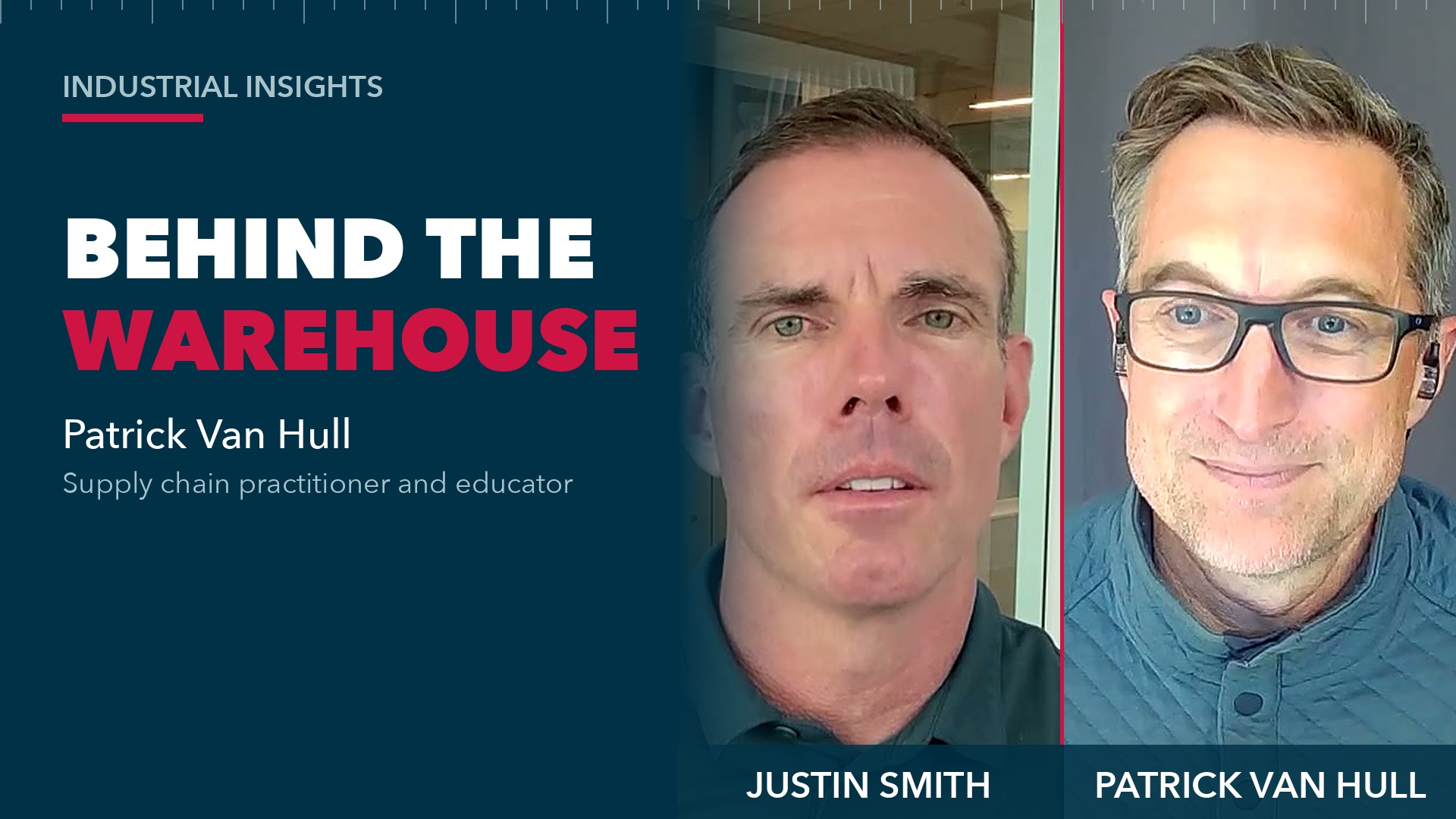
Watch the conversation
Listen to the episode
Patrick Van Hull taught my supply chain strategy class at the University of Arkansas. I knew him first through the classroom, so this conversation was a chance to spend more time on the experiences he brought into it. His career has taken him through Dell, Rio Tinto Minerals, Apple, CVS Health, executive advisory work, and now Salesforce. Each gave him a different view of how products move and how companies make decisions.
For those of us in industrial real estate, there is a lot to learn from that perspective. We help companies find and negotiate space, but the requirements for that space come from a much larger set of choices: where to hold inventory, how quickly to serve customers, what to do internally, and where a partner can do it better.
The business decisions behind a building
Patrick started at Dell after studying industrial engineering at the University of Michigan. He describes learning how factory processes, plant layouts, and financial performance fit together. Later roles exposed him to mine sites, ports, consumer electronics, and store shelves.
One story makes those connections tangible. At Rio Tinto, Patrick recalls an unexpected increase in demand from a glass manufacturer. The connection turned out to be iPhone screens. A business that seemed far removed from consumer technology was only a couple of links away from it.
We also talk about an advisory conversation with a medical device company struggling to distribute products in sub-Saharan Africa. Patrick describes the team reconsidering its investment in an in-house operation and weighing the use of a local distributor. The question brought service, staffing, equipment, procurement, and real estate into the same discussion. That is useful context for anyone helping a company evaluate its footprint.
What changes inside the warehouse
Customer expectations affect how a building operates. Patrick talks about the shift from loading large trailers toward supporting more varied deliveries. I share an example from musical-instrument e-commerce, where product size, value, inspections, returns, and customer service all influence the work happening inside the warehouse.
That led us into forecasting and network design. Learning more about those disciplines helped me understand the decisions our clients are making before a real estate requirement reaches us. A building search tells us what a company needs today. Understanding the operation helps us ask better questions about what it may need next.
Bringing experience into the classroom
Patrick explains how a connection through his Gartner work brought him into the University of Arkansas program as demand for its courses grew. He had the flexibility to shape an online course around the ways he thought working professionals could learn and apply the material.
His standard is practical: can a student take something from the course and use it at work? That resonated with me. Network design and optimization were a major reason I entered the program. Studying while working meant I could connect new concepts to problems I was already trying to solve.
AI brings him back to industrial engineering
Patrick describes his work at Salesforce as a return to some of his earliest interests: understanding how work gets done and finding ways to improve it. Supplier onboarding, invoicing, order management, and warehouse documentation may be routine, but they affect larger questions about inventory, working capital, and performance.
His approach is to work backward from the business outcome to the process getting in the way. Where does information stop moving? Which handoff requires unnecessary manual work? Which decisions still need human judgment? Those questions give the technology a specific job to do.
Knowing how to find the answer
We finish with a discussion about confidence and continuing to learn. Patrick encourages people early in their careers to demonstrate how they can work through a question, even when they do not know the answer at the outset.
That is something I took from the conversation as well. More experience gives us more to draw from, and continuing to learn gives us better questions to ask. Whether you work in real estate, operations, or supply chain, understanding the work around your own role can make you more useful to the people you serve.
Episode chapters
- 00:00 How delivery requirements shape warehouses
- 00:15 Patrick’s career and the experience behind his teaching
- 03:46 From a mine to an iPhone screen
- 05:26 Industrial engineering in the AI era
- 07:53 Inventory, delivery, and the warehouse requirement
- 10:11 Forecasting demand when the signals change
- 11:50 Executive advisory at SCM World and Gartner
- 16:50 Build in-house or work with a distributor?
- 18:23 Joining Arkansas and keeping the program current
- 21:19 Teaching lessons working professionals can use
- 24:37 Network design and human judgment
- 27:59 Salesforce and the workarounds inside everyday processes
- 30:25 Working capital and underlying processes
- 33:56 Raising the floor and learning to find an answer
- 36:39 Mentoring and owning your perspective
Download the edited English captions
What does your operation need from its next facility?
Start with how products move, the service your customers expect, and the decisions the building needs to support.
Talk with Justin about your facility decision