Industrial Insights Podcast
Jeff Janda on Chicago Industrial, Client Trust, and Building Lee
Chapters
- 00:00 Jeff Janda and the Chicago office
- 00:47 Building Lee in Chicago
- 03:45 Running a broker owned office
- 05:30 Chicago industrial geography
- 10:10 Serving clients across the market
- 14:17 Lessons from Jim Planey
- 15:59 Chicago and California lease structures
- 17:10 Cook County taxes and incentives
- 22:22 Institutional ownership
- 24:43 Rents, land, and redevelopment
- 28:25 Renewal negotiations
- 33:06 Data centers and industrial demand
- 34:58 Owning industrial property
- 38:02 Mentoring the next generation
- 39:34 Technology and personal relationships
From the conversation
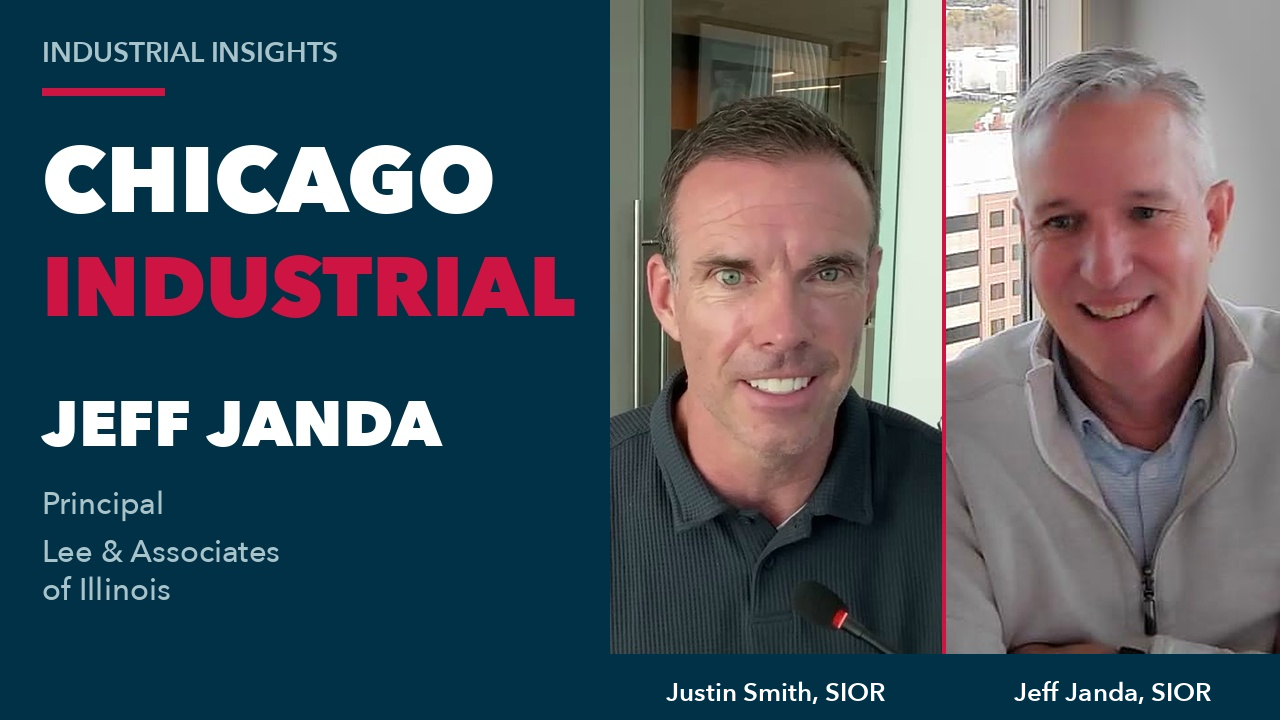
Jeff Janda, SIOR, Principal at Lee & Associates of Illinois, joins Justin Smith, SIOR, on Industrial Insights to talk about the Chicago industrial market and the relationships that have shaped his career.
Jeff helped build Lee’s Chicago office and brings an owner’s perspective to his work with clients. In this conversation, we discuss how the office operates, what a broker from another market needs to understand about Chicago, and the lessons Jeff carries forward from his mentor and longtime partner, Jim Planey.
Building a firm and working with the right people
Jeff looks back on helping establish Lee in Chicago and the partnerships behind the office. He describes an executive committee whose members share finance and other responsibilities while continuing their brokerage work. On client assignments, he brings in colleagues with the right local knowledge instead of trying to be the expert in every neighborhood.
Understanding Chicago beyond the rent quote
Chicago’s industrial market covers a wide range of locations and buildings. Jeff discusses how geography affects the alternatives available to a tenant, including the differences between space around O’Hare and properties farther from the airport. He explains why a rent comparison needs the building type, location, and occupancy costs behind the number.
We also discuss the differences a California broker encounters in Chicago, including annual versus monthly rent quotations and gross versus net lease structures. Jeff explains why property taxes belong in the occupancy-cost conversation and why an incentive’s remaining term can matter when a tenant is considering a lease.
Giving clients straight advice
Jeff’s recollections of Jim Planey bring the conversation back to reputation. He describes the importance of telling clients what they need to hear, including when that advice may cost the broker an assignment. When the conversation turns to renewals, Jeff explains how he considers the landlord’s incentives, the building, and the tenant’s alternatives.
What ownership teaches a broker
Jeff owns interests in buildings with partners and is careful about competing with his brokerage clients. As an owner, he considers tenant retention, fair treatment, preventive maintenance, and reserves for future repairs. We talk about how those responsibilities influence the way he evaluates a renewal and the value of maintaining a good tenant relationship over time.
Making time for the next generation
Jeff closes with advice for younger brokers and the people mentoring them. A mentor needs to invest time and resources, help an associate learn how to serve clients, and eventually give that person room to take responsibility. Technology can help with the work, but Jeff still values making time to see clients in person.
Guest: Jeff Janda, SIOR, Principal, Lee & Associates of Illinois. Host: Justin Smith, SIOR.
Rent examples and market observations reflect the interview and the specific property context discussed. Tax-incentive eligibility and lease obligations depend on the property and applicable documents.
Clips and trailer (13)
Running a broker owned office
Chicago industrial geography
Finding the right local expert
Reputation and client trust
Chicago and California lease structures
Property taxes and incentives
O’Hare rents and building types
Renewal negotiations
Long term ownership
Mentoring the next generation
The personal touch
Episode trailer
Industrial Insights Research · from the Jeff Janda episode
Chicago industrial: the rent quote leaves out the tax bill
Jeff described a 1.4 billion square foot market with vacancy near 5 percent and a property tax system that changes what a building costs to occupy. This brief checks his numbers against the third-quarter reports, explains the Cook County incentive he raised, and sets Chicago beside our Southern California markets.
How Jeff reads the market
Jeff's view is that Chicago has never really been overbuilt. O'Hare sits at the center and is the most expensive submarket. The big distribution buildings are west and southwest along I-88 and I-55. The complication is Cook County, where property taxes are high enough that many tenants refuse to look there at all. Jeff thinks that reaction misses the math.
"But at the end of the day, the gross rents are about the same."
His point is that the landlord in the higher-tax county has to accept a lower base rent, so the building is worth less and the tenant's total cost ends up close. These are the numbers he gave on the show:
| Market size | 1.3 to 1.5 billion SF |
| Vacancy | roughly 5% |
| Under construction | about 18 million SF |
| O'Hare, Class A, 100,000 SF and up | mid-$15s to $18 per SF a year, net |
| Aurora, Naperville, Joliet, Bolingbrook | upper $6s to $9 per SF a year, net |
| O'Hare redevelopment land | about $2 million an acre, double a few years ago |
| Cook County taxes, with and without the incentive | about $1.75 against $5 to $6 per SF a year |
These are Jeff's working figures from the conversation (chapters starting at 5:30, 17:10 and 24:43), not published statistics. "Net" means taxes, insurance and maintenance are paid on top of the rent.
Checking Jeff's numbers against the third-quarter reports
- Market size. Confirmed. Lee & Associates' third-quarter overview puts Chicago's inventory at 1,384,061,736 square feet.
- Vacancy near 5 percent. Confirmed, with a spread. Lee's Chicago office reports 5.09 percent. CBRE reports 5.5 percent. Cushman & Wakefield reports 4.7 percent, unchanged for four quarters.
- About 18 million square feet under construction. This matches the Lee Chicago office count of 17.5 million. Other firms count differently, as the chart shows.
Chicago industrial space under construction, third quarter 2026, in millions of square feet
Lee national overview24.8
Lee Chicago office17.5
Cushman & Wakefield14.8
CBRE13.2
Sources: Lee & Associates, Q3 2026 Chicago Industrial Market Overview (PDF; its table shows 24.8 million and 5.37 percent vacancy, its text 25.8 million and 5.1 percent); Lee & Associates Chicago, Q3 2026 Chicago Industrial Market Report; Cushman & Wakefield, Chicago Industrial MarketBeat Q3 2026, October 7, 2026; CBRE, Chicago Industrial Figures Q3 2026, October 9, 2026. The firms track different sets of buildings.
Whichever count you use, the pipeline is growing. Cushman's figure is up 63.8 percent from a year ago, and CBRE's rose 10.4 percent in the quarter. Demand has kept up so far. The Lee Chicago office counted 6.8 million square feet of net absorption (space newly occupied minus space vacated) in the quarter, with 15 of 18 submarkets positive.
On rent, the Lee Chicago office shows asking net rent of $9.34 per square foot in O'Hare and $7.18 along I-80 near Joliet. Jeff's O'Hare range is higher because he was describing new Class A buildings, and the report's figure covers the whole submarket.
The Cook County incentive, and where things stand now
Cook County normally assesses industrial property at 25 percent of market value. Under the Class 6b incentive Jeff described, a qualifying building is assessed at 10 percent for 10 years, 15 percent in year 11 and 20 percent in year 12. The county lists the standard program as renewable. On assessment level alone, losing it multiplies the tax bill by 2.5, which is in line with Jeff's "3x" rule of thumb.
Source: Cook County Bureau of Economic Development, Property Tax Incentives, opened November 12, 2026. Eligibility depends on the property. Confirm with a tax attorney.
- October 15, 2026. EQT announced it will buy Stockbridge for $375 million plus up to $175 million in later payments. Jeff mentioned the deal on the show. EQT expects to close in the first quarter of 2027 and says it will combine the two industrial platforms.
- Third quarter 2026. Lee's report lists Amazon's $195 million purchase of 1237 W. Division Street in Chicago, 1,184,800 square feet, from Logistics Property Company. This is the downtown building Jeff mentioned.
- Third quarter 2026. CBRE reports that Joliet accounts for 6.3 million square feet of the year's net absorption, more than half the market total.
Sources: EQT press release, October 15, 2026; Lee & Associates overview and CBRE, as above.
Chicago beside our markets
Chicago quotes rent by the year. Southern California quotes it by the month. Converted, the Lee Chicago office's $8.06 marketwide asking net rent is about 67 cents per square foot a month, and Jeff's O'Hare Class A range is about $1.29 to $1.50.
| Chicago vacancy | 5.09% |
| Orange County vacancy | 6.4% |
| Los Angeles County vacancy | 6.8% |
| Chicago average sale price | $104 per SF |
| Inland Empire average sale price | $206 per SF |
| Los Angeles County average sale price | $288 per SF |
| Chicago cap rate | 8.09% |
| Inland Empire cap rate | 5.8% |
Sources: Lee & Associates Chicago for vacancy and rent; the Lee & Associates overview for Chicago sale price and cap rate (the yield a buyer earns on the purchase price); our Q3 2026 market pages for Southern California. The sources measure differently, so read these as a rough comparison.
What I have seen from the California side
I worked an assignment near O'Hare where the client told us they would look within 20 or 30 minutes of the airport but would not consider Cook County. We stayed out and signed about 40,000 square feet in a Class A building. When I told Jeff that story, he said he hears the same thing in first meetings all the time, and that the gross numbers usually come out close.
His tax-sharing structure made sense to me. I compared it on the show to a partnership waterfall where you split the taxes instead of the profits.
On renewal options, Jeff and I agree. As I said to him, an option priced above market guarantees you overpay, but it is an insurance policy if you need one. In Industrial Intelligence I wrote that I treat options as a low priority in most negotiations, and that 90 percent of the time my clients have one, we choose not to use it and start a new negotiation. I also wrote that most of the country quotes rent annually while Southern California quotes monthly, so make sure you know what is included in the number.
Sources: the conversation, in the chapters starting at 17:10 and 28:25; Industrial Intelligence, the sections on price per square foot and the lease option to extend.
If your company is looking at Chicago
- Convert the rent. Divide a Chicago quote by 12 before you compare it with a California one.
- Compare total cost across the county line. Add taxes and other expenses to the base rent before you rule Cook County in or out.
- Ask what year the incentive is in. Jeff's advice is to line the lease term up with the years the Class 6b has left.
- Ask the landlord to share the tax risk. Jeff has seen landlords agree to absorb part of the increase above a set level for a good-credit tenant.
- Expect the first renewal number to be a little above market. Jeff says many landlords count on the fact that a tenant will not move over 50 cents a foot.
What to watch next
- Fourth-quarter reports, due in January. Lee's overview expects vacancy to hold near current levels. CBRE expects more speculative big-box construction in the fourth quarter.
- The EQT and Stockbridge closing, targeted for the first quarter of 2027.
- Class 6b terms building by building. Each incentive runs 12 years, so the year a building is in matters more than any countywide date.
This brief is updated, with the date shown at the top, when any of these change.
Comparing a Chicago site with one in California?
We represent tenants across the country and work with Lee & Associates offices in each market. Send us what you are weighing.
Ask for a second opinionMore episodesKeep going on this topic
Planning your next industrial real estate decision?
Talk through the building, location and occupancy costs behind the rent quote.
Connect with Justin